

Selecting the right practice sword is one of the most consequential decisions you will make in your iaido training. The types of iaido practice swords available range from simple wooden bokken to precision aluminum-alloy iaito, and each serves a specific purpose tied to your skill level, dojo standards, and training goals. Choose wrong, and you compromise both safety and skill development. Choose right, and your sword becomes an extension of your discipline. This guide walks you through every major option, the criteria that separate a good choice from a poor one, and how to match your sword to where you actually are in your training.
Table of Contents
- How to evaluate iaido practice swords: key selection criteria
- Common types of iaido practice swords
- Comparative overview of iaido practice sword types
- Choosing the right iaido practice sword for your training goals
- Rethinking iaido practice swords: balancing tradition and safety
- Collector katanas from MoonSwords
- Frequently asked questions
Key Takeaways
| Point | Details |
|---|---|
| Material matters | Choose iaito made from aluminum or zinc alloys for safety and compliance with dojo rules. |
| Progression is key | Start with bokken before transitioning to iaito once you demonstrate readiness. |
| Safety first | Live blades are never for regular practice; use blunted iaito instead. |
| Custom options exist | Dedicated practitioners can opt for fully customized iaito suited to their needs. |
| Tradition and mindfulness | Iaido training emphasizes respect and mental focus, not just blade sharpness. |
How to evaluate iaido practice swords: key selection criteria
Before exploring specific sword types, you need a reliable framework for evaluating any iaido training sword. The wrong choice is not just a financial loss. It can set back your form, create unsafe conditions in the dojo, and signal to your instructor that you are not ready for the next stage of practice.
Here are the core criteria every practitioner should evaluate:
- Material composition: Aluminum-alloy or zinc-alloy iaito are the only types permitted for regular dojo training. These materials replicate the weight and balance of a real katana without the danger of a live edge.
- Blade sharpness: Live blades are prohibited in standard practice environments. Any sword with a sharpened edge introduces unnecessary risk and is typically banned by serious iaido organizations.
- Weight and balance: A sword that is too light will allow sloppy technique. Too heavy, and it fatigues the practitioner before proper form is internalized. The ideal iaito closely mirrors the mass distribution of a traditional shinken (live blade).
- Length and fit: Iaido is deeply personal. Your sword’s nagasa (blade length) should be matched to your body proportions. An ill-fitting sword forces compensatory movement that creates bad habits over time.
- Durability and maintenance requirements: Wooden swords absorb humidity and can crack. Metal training swords require periodic cleaning and inspection for corrosion at the habaki (blade collar) and nakago (tang). Understanding upkeep before you buy avoids surprises later.
- Practitioner level and dojo rules: Most dojos have explicit policies on which sword types are permitted at each stage of training. Always confirm requirements with your sensei before purchasing.
Pro Tip: Before investing in an iaito, consult your dojo management resources or instructor to confirm which swords are approved for your school’s curriculum. Different organizations, such as the All Japan Kendo Federation, have specific regulations that govern what is acceptable.
Craftsmanship matters too. A sword built with tight tolerances at the tsuba (hand guard) and proper weight at the kissaki (tip) will train your wrists and grip far more effectively than a mass-produced piece. When you browse pay attention to how the maker describes balance points and material sourcing. These details are not marketing language. They are construction specifications.
Now that we understand the essential criteria for choosing iaido practice swords, let us explore the main types available to martial artists.
Common types of iaido practice swords
Understanding each category of iaido sword types is essential before committing your money or your training to one. Each type has a defined role in the learning path, and skipping stages rarely ends well.
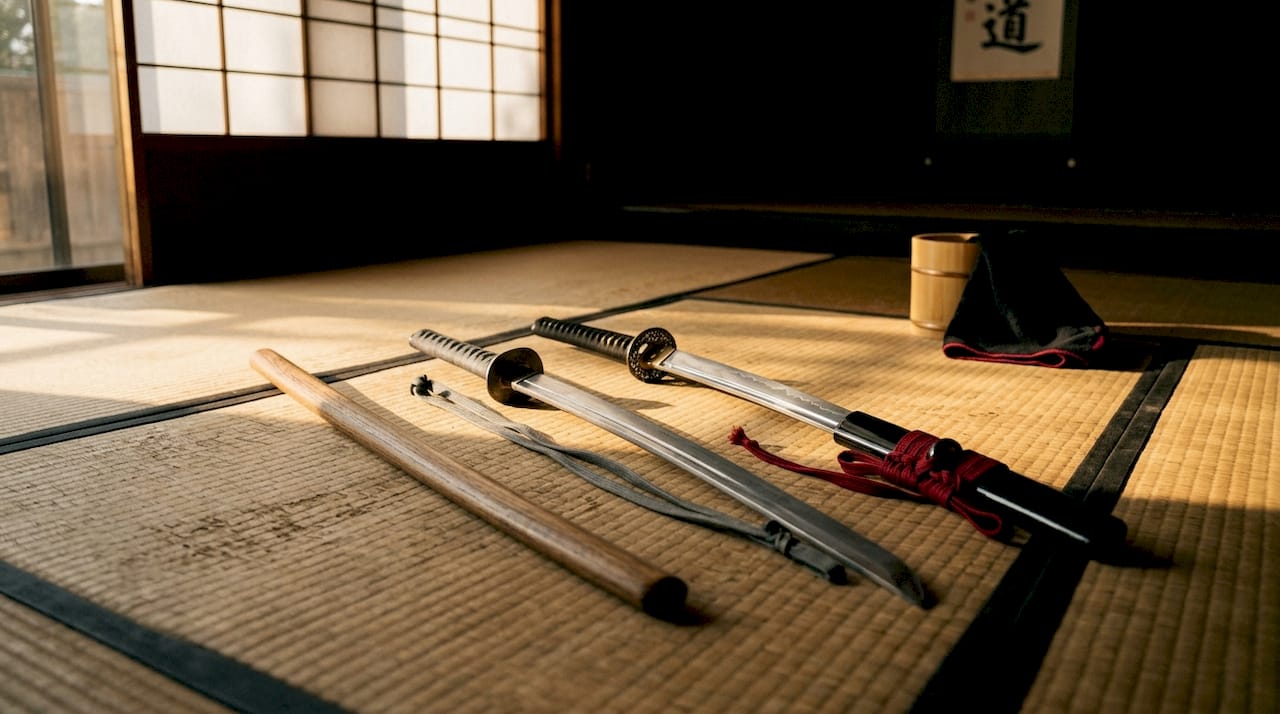
Bokken (wooden practice sword)
The bokken is where most iaido students begin. It is a solid wooden sword, typically carved from oak or red oak, shaped to approximate the dimensions and curve of a katana. The bokken teaches you the foundational mechanics of drawing, cutting, and resheathing without the weight or edge of a real blade.
Key characteristics of the bokken:
- Constructed from hardwood, most commonly white oak or red oak
- Lightweight compared to a real katana, which limits its effectiveness for advanced waza (techniques) but makes it ideal for beginners
- Inexpensive, durable enough for repeated kata (choreographed form) practice
- Cannot simulate the realistic weight and balance of an iaito at the intermediate or advanced level
The bokken’s simplicity is its strength for early-stage learners. It forgives minor grip errors that a heavier sword would amplify into physical strain. Think of it as the foundation of a building. Without it, nothing else stands correctly.
Iaito (aluminum or zinc-alloy training sword)
An iaito is a precision training tool and must be selected carefully. It is a metal training sword specifically designed for iaido practice, produced without a sharp edge. The alloy composition gives it a realistic mass and balance that closely mirror those of a shinken, making it the primary training weapon at the intermediate and advanced levels.
What distinguishes a quality iaito:
- Blade crafted from aluminum or zinc alloy for safe, edge-free practice
- Weight and balance calibrated to replicate the feel of a live blade
- Available in standard sizing and fully custom configurations
- Custom iaito can be ordered to exact specifications, including blade length, sori (curvature), tsuka (handle) length, and fittings
Shinken (live blade)
The shinken is a fully sharpened steel katana. It represents the pinnacle of Japanese sword craftsmanship and is the ultimate expression of what iaido trains you to handle. However, it is not a training tool for regular practice. Most dojos prohibit shinken use in class entirely.
Shinken are reserved for:
- Advanced practitioners with years of verified experience
- Formal demonstrations or competitions where live steel is specifically required
- Personal ownership as a collector’s or display piece
Owning a shinken before you are genuinely ready is not a mark of seriousness. It is a safety liability.
Custom iaito
For dedicated students past the beginner stage, custom iaito represent a significant investment in their craft. These are made to your precise measurements, handle preferences, and aesthetic choices. The experience of drawing and resheathing a sword built specifically for your body is qualitatively different from using a stock model.
A typical progression looks like this:
- Begin with bokken to develop fundamental form and safe handling
- Demonstrate consistent attendance, safe bokken technique, and reishiki (dojo etiquette) before advancing
- Transition to a standard iaito approved by your instructor
- Consider a custom iaito after establishing intermediate-level technique and confirming sizing preferences
Understanding these sword types sets the stage to compare their key characteristics side by side for deeper insights.
Comparative overview of iaido practice sword types
The table below gives you a structured comparison of the main iaido sword types across the criteria that matter most to active practitioners.
| Feature | Bokken | Standard iaito | Custom iaito | Shinken |
|---|---|---|---|---|
| Material | Hardwood (oak) | Aluminum or zinc alloy | Aluminum or zinc alloy | High-carbon steel |
| Edge | Blunt (wood) | Blunt (metal) | Blunt (metal) | Sharp (live blade) |
| Safety level | High | High | High | Low (sharp) |
| Realistic weight | Low | Moderate to high | High (personalized) | High |
| Price range | $20 to $80 | $200 to $700+ | $892 and above | $500 to several thousand |
| Maintenance | Inspect for cracks, oil wood | Clean metal, inspect fittings | Same as standard iaito | Professional sharpening, full care regimen |
| Recommended level | Beginner | Intermediate | Intermediate to advanced | Advanced only |
| Dojo permitted | Yes | Yes | Yes | Rarely |
Custom builds typically begin around $892 and can easily exceed $1,000 depending on fittings and upgrades, with lead times running three to four months. That timeline matters when you are planning your training progression, so order early.
Pro Tip: If you are considering a high-end iaito or want to understand what premium blade construction looks like in practice, study the construction details behind pieces like our tsuchime damascus katana or the clay-tempered steel in our akitsu katana. These showcase what intentional craftsmanship looks like at the material level.
Plastic iaido swords also exist on the market, typically molded from rigid polymers. They are used primarily for children’s training or introductory demonstrations but lack the realistic weight and balance of alloy iaito. We generally do not recommend plastic iaido swords for serious practitioners beyond the most introductory context.
With this comparison in mind, let us explore which types of iaido practice swords suit different training goals and scenarios.
Choosing the right iaido practice sword for your training goals
The right iaido sword for training is not the most expensive one, and it is not the one that looks most impressive. It is the one that serves where you actually are right now.
Here is how to think about it by practitioner stage:
Beginners
- Start with a quality bokken. Focus entirely on form, posture, and safe drawing mechanics.
- Avoid the temptation to buy an iaito before your instructor advises it. You will likely develop poor habits with a heavier weapon before your technique can support it.
- Use this stage to study reishiki and build the consistent attendance record your dojo will look for before approving your advancement.
Intermediate practitioners
- Students typically transition to iaito after demonstrating consistent attendance, safe bokken handling, and understanding of reishiki.
- At this stage, a standard-sized aluminum-alloy iaito is appropriate. Confirm blade length and tsuka length with your instructor before purchasing.
- Budget for the $200 to $500 range for a reliable mid-tier iaito. Underspending here often means replacing the sword within a year.
Advanced practitioners
- A custom iaito becomes a worthwhile investment once your technique is stable and your sizing preferences are well established.
- Advanced students who own shinken should still train in dojo settings exclusively with their iaito. The shinken is for demonstration and collection.
Use this numbered approach to guide your purchase decision:
- Confirm your dojo’s sword requirements and permitted materials
- Assess your current technique level honestly, in consultation with your sensei
- Set a realistic budget that accounts for quality fittings and appropriate materials
- Consider a martial arts price comparison to understand your options across suppliers
- Prioritize fit and balance over aesthetics at every stage
Pro Tip: If budget is a constraint, a well-made bokken from a reputable supplier and a mid-range iaito from a trusted craftsman will serve you far better than an expensive shinken you are not ready for. We offer pieces like our samurai collectible katana and our damascus steel katana as reference points for what full-tang, hand-forged construction delivers at the collector level.
Rethinking iaido practice swords: balancing tradition and safety
We want to offer a perspective that most beginner guides miss entirely. The conversation about iaido sword types is almost always framed around safety and cost. What rarely gets said is that the choice to train with a blunted iaito rather than a shinken is not a compromise. It is a philosophical alignment with the art itself.
The ultimate essence of iaido is not to cut but to sheath the sword without conflict, reflecting respect and self-discipline. Read that again. The art is not about the sharpness of the blade. It is about the stillness and intent of the practitioner.
Training with a safe, well-made iaito does not diminish your practice. It actually focuses your attention where it belongs: on posture, breath, drawing precision, and the mental clarity required to execute each waza without hesitation. The shinken becomes meaningful only when you have already embodied that discipline with a blunt blade.
We also think the martial arts community sometimes underestimates the value of wooden iaido practice swords at the beginning stage. The bokken forces you to develop power and control without relying on the inertia of a heavier metal blade. Practitioners who skip the bokken stage often show it in the rigidity of their cuts and the tension in their shoulders years later.
Modern training tools like the iaito have made this art more accessible without cheapening it. That accessibility matters. It allows more people to experience the meditative quality of drawing and resheathing a sword with complete intention, which is the whole point.
Collector katanas from MoonSwords
At MoonSwords, we understand that a sword is not just an object. It is a commitment to the art.

Our collection at MoonSwords includes handcrafted blades forged by master artisans using traditional techniques like clay tempering and full tang construction. Whether you are looking for your first authentic katana or adding a collector-grade piece to your display, we have full-tang, hand-forged options built to the standards the art demands. Our black dragon katana and hayabusa wakizashi are two examples of the construction quality we bring to every piece. Explore our full catalog to find the collector piece that matches your taste, your budget, and your respect for this tradition.
Frequently asked questions
What is the difference between an iaito and a shinken sword?
An iaito is a blunt-edged practice sword made from aluminum or zinc alloy, approved for regular dojo training, while a shinken is a fully sharpened live blade reserved for advanced practitioners and demonstrations only. Only aluminum or zinc-alloy iaito are permitted in standard dojo settings.
When should a student transition from using a bokken to an iaito?
Students transition to iaito after demonstrating consistent attendance, safe bokken handling, and a solid understanding of reishiki (dojo etiquette), typically as confirmed by their sensei.
Can live blades be used for regular iaido practice?
No. Live blades (shinken) are not permitted in regular practice due to the serious safety risks they present and are reserved strictly for advanced demonstrations or specific sanctioned uses.
What factors should I consider when purchasing a custom iaito?
Focus on blade length relative to your body measurements, tsuka length, quality of fittings, and realistic budget planning since custom builds start around $892 and can exceed $1,000, with lead times of three to four months.