

Framing a sword with cultural artifacts is the practice of mounting a blade within a composed display that integrates historically or regionally significant objects, such as carved wood panels, silk textiles, metal fittings, or inlaid shell, to honor both the weapon’s origin and its aesthetic power. Done correctly, this approach transforms a sword from a static wall piece into a layered narrative object. At Moonswords, we work with collectors who want their katanas, jian, and dao to tell a complete story, not just hang on a wall. The right combination of inert framing materials and culturally matched artifacts protects the blade while making the display genuinely memorable. Tools like Tru Vue Optium Museum Acrylic® and Renaissance Wax are the professional standard for this kind of work.
What cultural artifacts can be used to frame a sword?
The artifacts you choose define the cultural identity of the entire display. Selecting the wrong materials, or mixing artifacts from unrelated traditions, produces a display that feels decorative rather than meaningful. The goal is thematic coherence: every object in the frame should belong to the same cultural or historical conversation as the sword itself.
Here are the most common artifact categories used in professional and collector-grade sword framing:
- Textiles: Silk brocade panels, embroidered clan banners, or dyed linen backings are used behind Japanese katanas, Chinese dao, and European longswords respectively. Silk is particularly effective because its sheen complements polished steel without competing with the blade’s hamon or hada.
- Carved wood elements: Lacquered wood frames, relief-carved panels depicting dragons or phoenixes, and wooden mon (family crests) are standard in Japanese and Chinese displays. The grain and finish of the wood should complement the sword’s handle wrapping (ito) and scabbard (saya).
- Metal fittings and tsuba: Displaying a spare tsuba (hand guard), habaki (blade collar), or fuchi-kashira (handle fittings) alongside the blade gives collectors a complete picture of the sword’s hardware tradition. These fittings are often the most culturally specific objects in the frame.
- Inlaid shell and bone: Mother-of-pearl inlay panels are common in Middle Eastern and Southeast Asian sword displays. Bone or ivory-effect inlays appear in some Central Asian and Ottoman framing traditions.
- Calligraphy scrolls or paper documents: Certificates of authenticity, historical provenance documents, or hand-brushed calligraphy in Chinese or Japanese add scholarly weight to a display. These must be protected behind UV-filtering glazing.
- Natural materials: Dried botanicals, river stones, or raw silk cocoons are used in minimalist Japanese displays to evoke wabi-sabi aesthetics. These require careful off-gassing management inside sealed frames.
Authentic artifacts carry more weight than replicas, but replicas are acceptable when the original is too fragile or too valuable to risk inside a sealed frame. The key consideration is cultural relevance and thematic coherence: a Tang dynasty dao should not share a frame with Edo-period Japanese fittings. When in doubt, consult a specialist or keep the artifact selection narrow and precise.
Pro Tip: If you are framing a katana, pair it with a tsuba from the same school or period rather than a generic decorative piece. The specificity signals to any informed viewer that the display is curated, not assembled.
How to prepare tools, materials, and environment for framing
Preparation is where most collectors underestimate the complexity. Aesthetic framing alone cannot solve the preservation risks that come with enclosing a metal blade alongside organic materials. Microclimate control and case design provide the essential preservation environment, and that environment must be planned before a single artifact is placed.

Essential materials at a glance
| Material | Purpose | Standard |
|---|---|---|
| Tru Vue Optium Museum Acrylic® (6mm) | UV filtering, anti-reflection glazing | Museum grade |
| Acid-free foam board or Coroplast | Inert backing and mounting substrate | Conservation grade |
| Renaissance Wax | Metal surface protection, oxidation prevention | Archival grade |
| Silica gel packets or trays | Humidity buffering inside sealed frame | 40–50% RH target |
| Stainless steel or brass hardware | Mounting brackets and sword supports | Non-reactive |
| Archival linen tape or Velcro | Securing textiles without adhesive damage | pH neutral |
Using inert framing components like museum-quality acrylic, acid-free boards, and UV-filtering glass prevents deterioration of culturally significant swords. This matters because the blade and the artifacts age at different rates, and the wrong framing material accelerates that process for both.
Materials inside the frame must also pass chemical safety standards. Wood acids, oil-based paints, and acetoxy silicones pose direct risks to metal and organic artifacts inside sealed cases. The Oddy test, a standard used by conservators at institutions like the Smithsonian and the Victoria and Albert Museum, screens materials for reactive gas emissions. If you are sourcing decorative wood panels or adhesives, ask your supplier whether the material has been Oddy tested.
Environmental controls extend beyond the frame itself. Mount the display away from exterior walls, heating vents, and direct sunlight. The ideal ambient conditions for a mixed-material sword display are 65 to 70 degrees Fahrenheit and 40 to 50 percent relative humidity. Motion-sensor conservation lighting, which activates only when a viewer is present, minimizes light-induced degradation without sacrificing the visual impact of the display.
Pro Tip: Silica gel inside a sealed frame is not a set-and-forget solution. Indicating silica gel (the type that changes color when saturated) lets you monitor humidity without opening the case. Recharge it in an oven at 250°F for two hours when it signals saturation.
Step-by-step methods to frame a sword with cultural artifacts
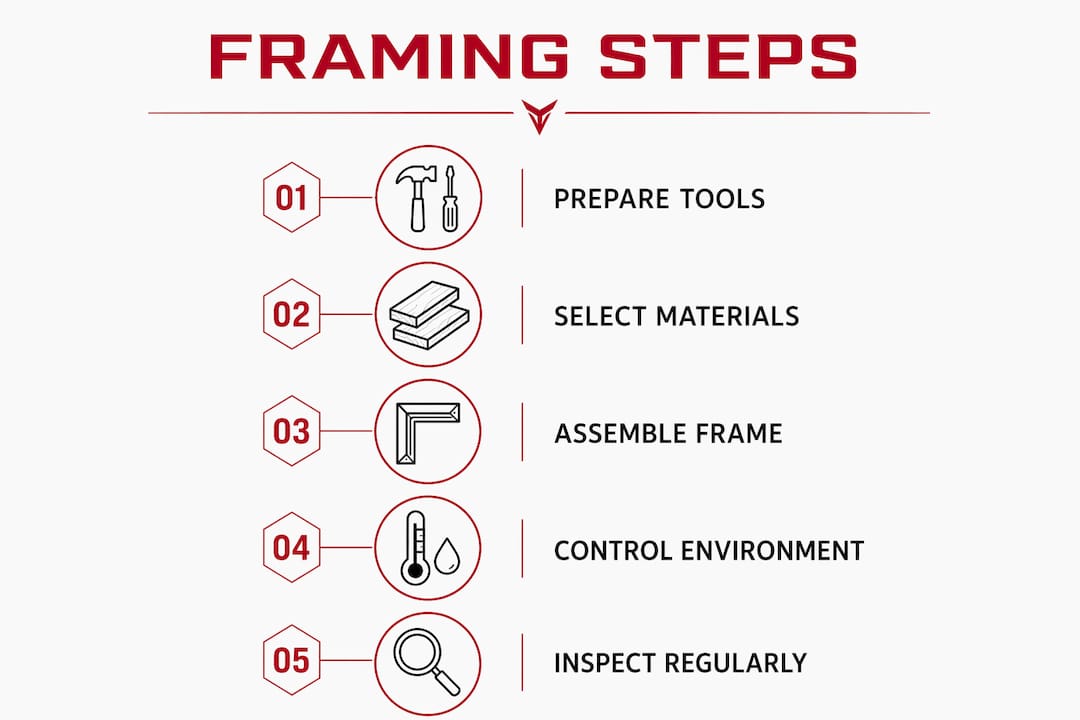
This process assumes you have gathered your materials, selected your artifacts, and prepared your environment. Work on a clean, padded surface and wear nitrile gloves throughout. Skin oils accelerate oxidation on both metal and organic materials.
-
Assess the sword and artifacts for pre-existing damage. Examine the blade for rust, pitting, or loose fittings. Check textiles for tears, mold, or insect damage. Any active deterioration must be addressed before framing. Enclosing a damaged object accelerates its decline. If the blade shows active rust, treat it with a light application of choji oil before proceeding.
-
Apply Renaissance Wax to all metal surfaces. Renaissance Wax is formulated without acids or reactive ingredients, providing a protective coating that prevents oxidation and fingerprints. Apply a thin coat with a soft cloth, allow it to cure for five minutes, then buff to a light sheen. Do not apply wax to the cutting edge or any surface that will contact mounting hardware directly.
-
Prepare the backing board. Cut your acid-free foam board to fit the interior of your frame. If using a textile backing (silk brocade, for example), stretch it over the board and secure it with archival linen tape at the rear. Keep the textile taut but not distorted. The backing sets the visual tone for the entire display.
-
Arrange and secure the artifacts. Place your artifacts on the backing board before committing to any attachment. Photograph the arrangement from the viewing distance to check visual balance. Secure lightweight artifacts (calligraphy, paper documents) behind a secondary acrylic sheet. Mount heavier objects (tsuba, carved wood panels) with stainless steel pins or brass standoffs set into the foam board. Never use hot glue, rubber cement, or any solvent-based adhesive inside a conservation frame.
-
Mount the sword. Use padded stainless steel or brass brackets, or custom-cut foam cradles covered in acid-free fabric, to support the blade at two points: near the habaki and near the tip. The sword should rest without tension or torque. For a katana, the blade traditionally faces edge-up (ha-muki) when displayed in a horizontal frame. Check the sword condition grading of your blade before deciding on mounting orientation, as some antique blades require additional support.
-
Place silica gel and seal the frame. Distribute silica gel packets evenly behind the backing board or in concealed trays at the frame’s edges. Seal the frame with the Tru Vue Optium Museum Acrylic® front panel, using a gasket or foam weather seal around the perimeter to create a stable microclimate. Sealed lids and buffering materials greatly minimize environmental risks for mixed-material displays.
-
Final visual check and installation. Hang the frame at eye level on a load-bearing wall stud. Step back and assess the thematic storytelling: does the eye move naturally from the artifacts to the blade and back? A well-composed display has a visual hierarchy, with the sword as the primary subject and the artifacts as supporting context.
Troubleshooting common issues and maintaining your display
Even a well-constructed frame requires periodic attention. The following problems are the most common in mixed-material sword displays, along with their solutions.
- Oxidation on the blade: A light rust bloom inside a sealed frame usually indicates humidity has exceeded 55 percent. Open the frame, treat the blade with choji oil, reapply Renaissance Wax, replace the silica gel, and reseal. Renaissance Wax’s reversible and stable nature makes it safe to reapply without risk to the original surface.
- Textile fading or discoloration: This is almost always a UV exposure problem. Verify that your glazing is Tru Vue Optium Museum Acrylic® or equivalent UV-filtering material. If fading continues, check whether ambient light from windows is reaching the display at an angle not blocked by the glazing.
- Artifact off-gassing: Organic materials like lacquered wood, certain adhesives, and natural dyes can emit reactive gases inside a sealed enclosure. Mixed heritage framing requires careful environmental management because off-gassing accelerates corrosion on metal surfaces. If you detect a chemical odor when opening the frame, identify and remove the offending material. Replace it with an Oddy-tested alternative.
- Artifact shedding or movement: Lightweight objects can shift over time if mounting adhesive degrades. Inspect all artifact attachments annually and re-secure any loose pieces with fresh archival tape or new brass pins.
- Condensation on the acrylic: This signals a large temperature differential between the frame interior and the room. Improve room climate control or add a thermal buffer layer between the wall and the frame backing.
When deterioration is severe, or when a blade is a genuine antique with significant monetary or historical value, professional conservation is the right call. Institutions like the American Institute for Conservation maintain a directory of certified conservators who specialize in arms and armor.
Key takeaways
Framing a sword with cultural artifacts requires inert materials, microclimate control, and thematic coherence to produce a display that is both visually compelling and preservation-grade.
| Point | Details |
|---|---|
| Choose artifacts with cultural precision | Match artifacts to the sword’s specific tradition, period, and region for a coherent display. |
| Use conservation-grade materials | Tru Vue Optium Museum Acrylic® and acid-free boards prevent chemical damage to blade and artifacts. |
| Apply Renaissance Wax before sealing | Coat all metal surfaces with Renaissance Wax to block oxidation inside the sealed frame. |
| Control humidity with silica gel | Use indicating silica gel inside the sealed case and recharge it when it signals saturation. |
| Inspect and maintain annually | Check artifact attachments, wax condition, and silica gel status every 12 months minimum. |
Why cultural framing is more demanding than it looks
By Kenji Smith
Most collectors I speak with underestimate how much the artifacts complicate the preservation equation. A bare sword on a wall is a relatively simple conservation problem: control humidity, avoid UV, apply wax. The moment you add a silk textile, a lacquered wood panel, or a paper document to the same sealed enclosure, you have introduced materials that breathe, off-gas, and respond to temperature in ways the steel does not.
The tension I find most interesting is between authenticity and safety. A 200-year-old silk obi is the most culturally appropriate backing for an Edo-period katana. It is also fragile, prone to off-gassing, and potentially carrying residual dyes that react with metal. A modern reproduction silk, Oddy-tested and pH-neutral, is safer but less honest. My own practice is to use authentic artifacts whenever their condition permits, and to document the compromise in writing when I substitute a reproduction. That documentation becomes part of the display’s provenance.
The other lesson I keep relearning is that the frame is not the end of the project. It is the beginning of a maintenance relationship. The collectors who get the most from their displays are the ones who treat the annual inspection as a ritual, not a chore. They open the frame, smell the interior, check the silica gel color, run a gloved finger along the blade. That kind of attention catches problems before they become damage. For deeper context on how Japanese interior design informs display philosophy, the principles of ma (negative space) and wabi-sabi are genuinely useful frameworks for artifact arrangement, not just aesthetic preferences.
The displays I am most proud of are the ones where a visitor stops, looks closely, and asks about a specific artifact. That curiosity is the point. The sword earns the attention; the artifacts earn the conversation.
— Kenji Smith
Start your framed collection with Moonswords
A culturally meaningful display begins with a sword worth displaying. Moonswords carries hand-forged katanas and collectible blades crafted by master artisans using clay tempering, full tang construction, and centuries-old forging techniques. Each piece arrives with the surface quality and metallurgical integrity that conservation-grade framing demands. Whether you are building your first antique sword showcase or expanding a serious cultural sword collection, the blade is the foundation. Browse the full range at Moonswords and find the piece your next display is built around.
FAQ
What artifacts pair best with a Japanese katana display?
Tsuba (hand guards), silk brocade panels, and hand-brushed calligraphy scrolls are the most historically appropriate artifacts for a katana display. Matching the period and school of the fittings to the blade strengthens the display’s cultural authenticity.
How do I prevent rust inside a sealed sword frame?
Apply Renaissance Wax to all metal surfaces before sealing the frame, and include indicating silica gel to maintain relative humidity between 40 and 50 percent. Recharge or replace the silica gel when it signals saturation to keep oxidation conditions from developing.
What is Oddy testing and why does it matter for framing?
The Oddy test screens materials for reactive gas emissions that can corrode metal or degrade organic artifacts inside sealed cases. Wood acids and acetoxy silicones are common offenders, so any wood panel or adhesive used inside a conservation frame should be Oddy-tested before use.
Can I use replica artifacts instead of authentic ones?
Replicas are acceptable when the original artifact is too fragile or too valuable to risk inside a sealed enclosure. The key requirement is that the replica material passes chemical safety standards and does not introduce off-gassing or moisture risks to the blade.
How often should I open and inspect a framed sword display?
Inspect the display at minimum once every 12 months. Check the blade for oxidation, verify the silica gel color, examine artifact attachments for loosening, and look for any signs of textile fading or discoloration that might indicate UV exposure or humidity problems.