

Few crafts carry the weight of an entire civilization's spiritual identity. Sword making is one of them. Across continents and centuries, why sword-making became a sacred craft is a question that leads you deep into ancient ritual, philosophy, and the human desire to imbue objects with meaning beyond their function. From Bronze Age burial offerings to the meditation-like discipline of Japanese swordsmiths, the forge was never just a workshop. It was a sacred space where metal, spirit, and intention merged. We at Moonswords have spent years studying these traditions, and what we find most compelling is how consistently cultures separated by thousands of miles arrived at the same conclusion: a sword is not just a weapon. It is a vessel.
Table of Contents
- Key takeaways
- Why sword-making became a sacred craft: ancient origins
- Japanese sword making: the sacred tradition examined
- Sacred sword making across other cultures
- The ritual, craftsmanship, and materiality of sacred forging
- Applying sacred traditions in modern collecting and artisan practice
- My perspective on why sacred craft still matters
- Explore swords forged with this tradition at Moonswords
- FAQ
Key takeaways
| Point | Details |
|---|---|
| Swords as ritual objects | Bronze Age swords served ceremonial and diplomatic roles long before warfare defined their purpose. |
| Japan's spiritual model | The Kamakura period formalized sword-making as a sacred discipline tied to samurai identity and divine authority. |
| Cross-cultural sacredness | European, Chinese, and Viking traditions each developed distinct yet parallel spiritual frameworks around swordmaking. |
| Imperfection as presence | Handmade flaws in sacred objects signal authentic human and spiritual presence, not technical failure. |
| Living tradition for artisans | Understanding sacred sword-making traditions enriches both collecting and contemporary artisan practice. |
Why sword-making became a sacred craft: ancient origins
The story begins well before the samurai. Bronze Age swords from 1700 to 1100 BC were deposited in ritual contexts unrelated to combat. Archaeological sites in Sardinia's nuraghe tower complexes and German burial grounds have yielded swords placed with extraordinary care, surrounded by offerings, positioned as though laid to rest rather than discarded. These were not weapons that outlived their usefulness. They were objects of deliberate spiritual intent.
What this tells us about the history of sword crafting is profound. Swords represented access to power, both earthly and cosmological. Presenting a sword as a burial offering or diplomatic gift communicated something no other object could. It transferred authority. It spoke to divine sanction. The smith who made such a sword was not just a metalworker. He was a mediator between the material world and whatever forces were believed to govern fate and protection.
Evidence from ancient burial and ceremonial sites
The archaeological record across early civilizations paints a consistent picture:
- Swords placed in burial chambers in northern and central Europe, dating to the late Bronze Age, show no signs of combat wear, suggesting they were made specifically as grave goods
- Ritual sword deposits in rivers and lakes across the British Isles point to offerings made to water deities or ancestral spirits
- In ancient Egypt, ceremonial swords and bladed weapons were carried in processions tied to pharaonic authority and divine kingship.
- Greek heroes in mythology received blades from gods, reinforcing the cultural idea that a sword's origin was always partially divine.
This evidence establishes that ancient sword-making practices were embedded in cosmological thinking. The forge itself was a place where transformation occurred: raw ore became a weapon, and through ritual, that weapon became sacred. The smith held a special, sometimes feared, social position precisely because he controlled that transformation.
| Era | Region | Sacred use of swords |
|---|---|---|
| 1700–1100 BC | Sardinia, northern Europe | Ritual deposits, burial offerings, diplomatic gifts |
| 1000–500 BC | British Isles | River and lake offerings to water spirits |
| Ancient Egypt | North Africa | Ceremonial processions, symbols of divine kingship |
| Viking Age | Scandinavia | Named swords with ancestral spirits, passed across generations |
Japanese sword making: the sacred tradition examined
No culture made the sacred-craft significance of sword-making more explicit than Japan. The history of sword crafting in Japan spans over a thousand years, and its spiritual dimensions were not incidental. They were architectural. They were built into the system.
The Kamakura period (1185 to 1333) stands as the pivotal era when swordmaking was elevated from a skilled trade to an honored spiritual discipline. Under the patronage of the samurai government, swordsmiths gained social prestige comparable to that of priests and scholars. The katana was no longer a tool. It was understood to be the soul of the warrior, a concept so deeply embedded in Japanese culture that it shaped law, ceremony, and personal identity for centuries.
How the spiritual framework developed
-
Shinto ritual preparation. Before forging began, the smith would purify himself through ritual bathing, fasting, and prayer. The forge area was sanctified with paper streamers called shide, marking it as a sacred space. This was not tradition for tradition's sake. It was a genuine belief that spiritual impurity in the maker would transfer into the blade.
-
The folding process is devotion. The repeated folding of tamahagane steel was not only a technical necessity for distributing carbon content. Each fold was a meditative act, a physical prayer that took days of sustained focus and physical labor.
-
Clay tempering and the hamon. The application of clay along the blade before quenching created the hamon, the visible temper line that collectors and martial artists recognize immediately. The clay was mixed according to closely guarded formulas specific to each school of swordsmiths. This process gave the blade its characteristic hardness gradient and produced the hada, the grain pattern unique to each smith. These visual features were read as spiritual signatures.
-
Named swords and lineage. The most celebrated smiths, including Masamune of the Kamakura period, produced blades that carried their names across generations. Masamune's swords were believed to embody a kind of divine clarity. They cut with precision yet were said to draw no unnecessary blood. Legendary accounts describe his blades as peaceful, almost unwilling to harm without cause. Whether historical or mythologized, these stories reveal how spirituality in sword making was inseparable from a blade's reputation and value.
-
Apprenticeship as spiritual preparation. Apprentices in traditional swordsmiths' workshops spent years performing cleaning, maintenance, and observational tasks before touching metal. This was not inefficiency. It was the recognition that technical mastery and spiritual readiness had to develop together. You could not forge a sacred object if you were not prepared to receive its demands.
Pro Tip: If you are studying Japanese sword-making traditions as an artisan or collector, study the historical eras separately. The Kofun, Heian, and Kamakura periods each produced distinct blade geometries, and understanding the context for each helps you read the spiritual intention behind the form. Moonswords offers a detailed historical era collector's guide that connects these changes in form to shifts in cultural and spiritual meaning.
Sacred sword making across other cultures
Japan offers the most thoroughly documented case, but the cross-cultural evidence for why swordmaking became a sacred craft is strikingly consistent. Sacred craft significance around the sword appears in nearly every major civilization that mastered metallurgy.
European and Viking traditions
European medieval swords were bound tightly to Christian imagery and knightly virtue. Sword blades were inscribed with prayers and divine names. The cross-shaped hilt was not coincidental. It was intentional: holding a sword in prayer placed a cross in your hands. Knighting ceremonies involved the laying of a sword on an altar and priestly blessings over the blade before it was girded to the knight. The sword was understood as a divinely sanctioned instrument of justice, not merely violence.

Viking sword making carried a different but equally powerful spiritual charge. Swords were given personal names, like Gram from Norse mythology, and were believed to carry the spirits of ancestors or legendary animals. Some blades were deliberately broken and "killed" before burial to release their spirit. Sacred sword-making traditions across cultures consistently depict swords as living objects with agency and spiritual capacity, rather than passive tools.
Chinese sword making and the philosophy of Qi
Chinese sword making linked craftsmanship and spirituality through the lens of Confucian and Taoist philosophy. Where Japanese swords are seen as the soul of the warrior, Chinese swords are linked to harmony, balance, and the flow of Qi. The jian, often called the "gentleman's sword," was associated with scholarly refinement and ethical cultivation. It was a double-edged symbol of the balance of opposing forces.
The cultural importance of swords in China extended into cosmological thinking. Certain sword forms were believed to channel and redirect energy. Taoist priests carried ceremonial jian in ritual practice, using them to cut through negative spiritual forces. The smith who made such a blade carried a responsibility that went far beyond metallurgy.
| Culture | Spiritual framework | Sacred significance |
|---|---|---|
| Japan | Shinto and Zen Buddhism | Soul of the warrior, divine relic, spiritual lineage |
| China | Taoism, Confucianism | Qi alignment, ethical symbol, ritual instrument |
| Medieval Europe | Christianity | Divine sanction, justice, knightly virtue |
| Viking Scandinavia | Norse mythology | Ancestral spirit, living weapon, ceremonial burial object |
The ritual, craftsmanship, and materiality of sacred forging
What separates sacred sword-making traditions from ordinary craft is not just intention. It is the structure of the making process itself. The making of sacred craft objects involves devotional engagement, in which artisans shape the divine presence through material practice. This is a fundamentally different orientation from production-focused manufacturing.
The materials themselves carry meaning. Tamahagane, the raw steel produced from iron sand in a traditional tatara furnace, was considered a living substance. Its impurities were not flaws to be eliminated but characteristics to be worked with, respected, and understood. The folding and forging process was a negotiation between the smith's will and the material's nature.
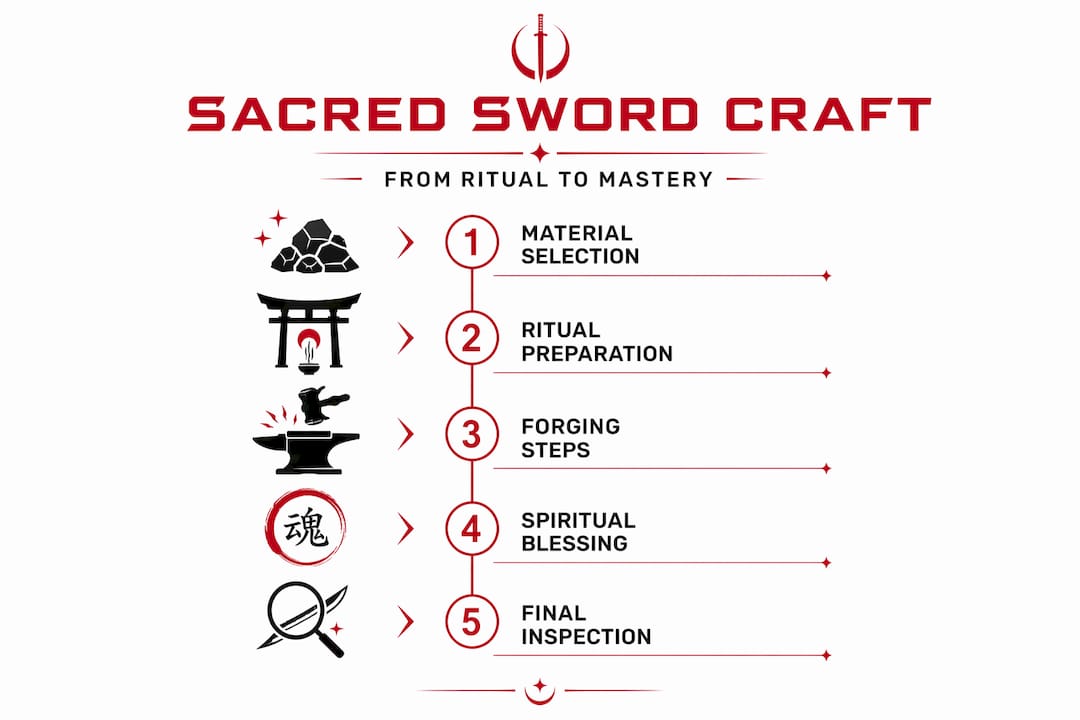
Sacred craft resists accelerated productivity by operating within seasonal and ritual timing rather than market efficiency. Traditional Japanese swordsmiths worked in winter, when cold water was available for quenching and when the shorter days imposed a natural discipline on the work pace. This alignment with ecological and cosmological rhythms was not a matter of practical convenience. It was a recognition that the forge existed within a larger order.
Pro Tip: When evaluating any handcrafted blade for your collection, look closely at the hada. The grain pattern tells you something about both the technical process and the attention the smith brought to folding and refinement. A blade with visible, consistent hada is evidence of time-intensive, devotional work.
Imperfection plays a specific and counterintuitive role in this framework. Artisans regard uneven edges or slight variations as spiritual marks that turn objects into vessels of authentic presence, not defects to be corrected. A flawless machine-produced blade carries no such mark. The slight asymmetry in a hand-forged sword tells you a human being was present, struggling, attending, and investing something of themselves in the work.
Applying sacred traditions in modern collecting and artisan practice
Understanding why swordmaking became a sacred craft is not merely an academic exercise for collectors and working artisans. It changes how you engage with every blade you own or make.
Here is how we recommend applying these insights:
- Research the lineage of your swords. Knowing which period, school, or cultural tradition a sword comes from gives you access to the spiritual and philosophical framework its maker worked within.
- Treat care as ritual. Cleaning and oiling a blade with attention and intention connects you to the same discipline that has defined sacred swordmaking across cultures. Use choji oil carefully, store blades correctly, and handle them with full attention.
- Resist purely aesthetic evaluation. Collectors who chase visual perfection above all else miss the deeper value of sacred craft. A blade with a complex, slightly irregular hamon may carry more presence than a technically perfect but sterile reproduction.
- Study the philosophy behind the form. Whether your interest is Japanese katana, Chinese jian, or European longswords, the geometry of a blade reflects a worldview. Learning that worldview deepens your relationship with the object.
- If you make blades yourself, slow down. Sacred craft is never hurried. The discipline of working deliberately, with attention to each stage, is the practice itself.
My perspective on why sacred craft still matters
I've spent enough time studying sword making traditions to know that the spiritual dimension isn't a romantic overlay people project onto old swords. It's structural. It's built into the how and why of making.
What strikes me most is that every culture we examine arrived at the same core insight independently: the quality of attention a maker brings to the work transfers into the object. That's not mysticism. That's craft knowledge. You can feel the difference between a blade made with care and one produced under pressure.
The challenge today is that modern production pressures work directly against the conditions that make sacred craft possible. Speed is valued over depth. Volume over presence. The imperfection that signals genuine human engagement in a handmade blade gets smoothed away by machines that optimize for consistency rather than character.
For collectors and artisans who understand these traditions, the responsibility is clear. Honor the process. Study the history. Treat your swords as objects that carry the intention of the people who made them, because they do.
—Kenji
Explore swords forged with this tradition at Moonswords
At Moonswords, we work with master artisans who understand that a sword is more than steel. Every blade in our catalog is produced using time-honored techniques including clay tempering, hand folding, and full tang construction, methods that trace directly to the sacred making practices this article describes.

Whether you are building a serious collection or searching for a blade that reflects centuries of spiritual craftsmanship, our high-end katana collection offers pieces made with the kind of attention and discipline that defines sacred craft. Explore the full range of hand-forged katanas and Chinese swords at Moonswords and find a blade whose presence you can feel.
FAQ
Why is sword-making considered a sacred craft?
Sword-making became a sacred craft because ancient cultures treated swords as objects of spiritual authority, not just weapons. Across Japan, China, Europe, and Bronze Age civilizations, the forging process involved ritual preparation, devoted attention, and the belief that a maker's spiritual state transferred into the blade.
What made the Japanese katana spiritually significant?
The katana was considered the soul of the samurai, a belief formalized during the Kamakura period, when swordmaking gained official patronage and swordsmiths performed Shinto purification rituals before forging. The combination of spiritual preparation, technical mastery, and named lineage made the katana as much a divine relic as a weapon.
How do imperfections in handmade swords relate to sacredness?
Handmade variations and slight irregularities in sacred craft objects are recognized as signs of authentic human presence and spiritual engagement. A blade with visible hada or a subtly irregular hamon carries the mark of a maker who was genuinely present, which is understood as a blessing rather than a flaw.
Did other cultures besides Japan treat sword making as sacred?
Yes. Viking smiths named their swords and believed them to carry ancestral spirits. European medieval tradition tied sword making to Christian divine sanction and knightly virtue. Chinese smiths working in the Taoist and Confucian traditions connected the jian and dao to the flow of Qi and ethical refinement.
How can modern artisans apply sacred sword making principles?
Modern artisans can apply sacred sword-making traditions by working deliberately, studying the philosophical framework behind the forms they are making, treating each stage of the forging process with full attention, and resisting the pressure to prioritize speed over presence. Sacred craft is defined by the quality of engagement, not the quantity of output.
Recommended
These papers are particularly valuable because they don't just recount the folklore; they bridge the gap between ancient cultural reverence and the actual metallurgical challenges historical master smiths faced.
References
Kucypera, P. (2017). Metal, Swords, and Birds. A Myth Spanning Time, Place, and Cultures. Fasciculi Archaeologiae Historicae, 30, 53–58. https://doi.org/10.23858/fah30.2017.005 Cited by: 3
Lobach, D. (2018). Medieval Sources of the Modern Symbolic Meaning of the Sword. Proceedings of the International Conference on Contemporary Education, Social Sciences and Ecological Studies (CESSES 2018). https://doi.org/10.2991/cesses-18.2018.172 Cited by: 6