

Understanding why sword maintenance affects safety is something every serious collector, martial artist, and historical weaponry enthusiast should grasp before picking up a blade. A sword that looks pristine in its display stand may harbor invisible dangers: micro-pitting in the steel, a loosening handle fitting, or corrosion eating through the blade’s core. This article walks through the structural, chemical, and practical realities of sword care, so you can handle your blade with confidence and protect both yourself and the investment you’ve made.
Table of Contents
- Key takeaways
- Why sword maintenance affects safety
- How rust and corrosion compromise a sword
- Proper sword maintenance techniques
- Common maintenance mistakes that increase risk
- Why maintenance is a safety practice, not a chore
- My honest take on sword maintenance culture
- Explore Moonswords’ hand-forged blade collection
- FAQ
Key takeaways
| Point | Details |
|---|---|
| Neglect creates real danger | Rust, loose fittings, and nicked edges can cause blade failure or unpredictable injury during handling. |
| Construction type matters | Full-tang construction is a baseline safety requirement; partial-tang blades carry higher structural risk under stress. |
| Rust acts faster than expected | Carbon and Damascus steel can develop rust spots within 12 to 24 hours of improper storage. |
| Maintenance is quick | Cleaning a display sword twice a year takes as little as 5 to 10 minutes and preserves both safety and condition. |
| Storage matters as much as cleaning | Leather sheaths trap moisture and tannins, actively accelerating corrosion on unprotected blades. |
Why sword maintenance affects safety
Most people treat sword maintenance as a cosmetic concern. Wipe off the fingerprints, maybe buff the blade, and call it done. That thinking is where accidents begin. The importance of sword care runs much deeper than surface appearance. A sword is a precision instrument built from carefully hardened and tempered steel, and every part of it, from the nakago (the tang that seats inside the handle) to the kissaki (the blade tip), is engineered to perform within specific tolerances.
When those tolerances are compromised by rust, physical damage, or loose fittings, the sword stops behaving predictably. A blade that catches on a nick, a handle that shifts in the hand, or steel that has been weakened by corrosion can fail suddenly. Structural failure is not a theoretical risk. It is a documented consequence of ignored upkeep.
Sword anatomy and where safety breaks down
Understanding sword construction helps clarify exactly where the risks live. Full-tang construction, where the steel extends the full length of the handle, is the gold standard for safety. A well-made sword pairs full-tang construction with properly heat-treated steel. Partial-tang swords, often found in decorative pieces, place enormous stress on a narrow steel stub inside the handle, and that stub can snap under pressure.
Common damage types to watch for include:
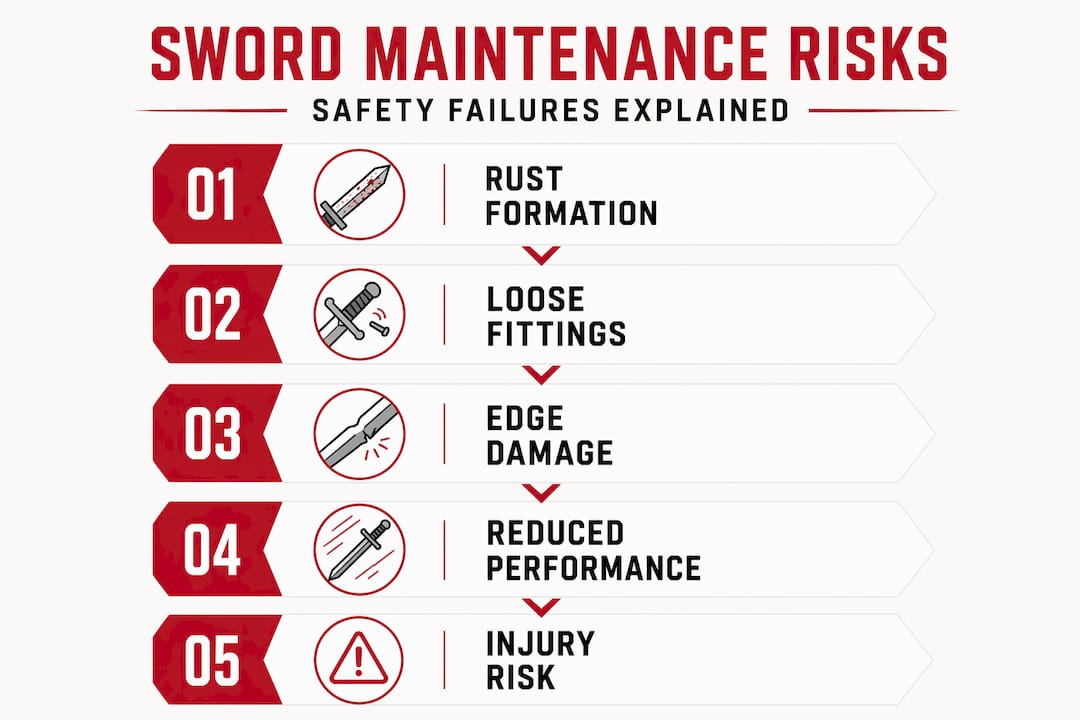
- Rust and surface corrosion: Reddish-brown oxidation that weakens the steel over time if left untreated
- Nicks and burrs on the edge: Irregularities that increase the risk of the blade catching unexpectedly during handling
- Loose tsuba (hand guard) or handle fittings: Shifting components that reduce control and can cause hand injuries
- Pitting: Deep corrosion craters that compromise the blade’s cross-sectional strength
A nicked or burred blade edge increases injury risk through unpredictable blade catch or breakage. Even a small nick can snag a cleaning cloth or the scabbard mouth when drawing and sheathing.
Pro Tip: Before handling or drawing your sword, run your thumb lightly along the spine (never the edge) to feel for unusual vibrations or movement at the fittings. Any looseness in the handle or tsuba deserves immediate attention before you handle the blade further.
How rust and corrosion compromise a sword
Steel rusts because of a simple electrochemical reaction: iron in the steel combines with oxygen and moisture to form iron oxide. The process accelerates with acids, salts, and humidity. For a katana or dao made from high-carbon steel or Damascus steel, this process can begin alarmingly fast.
| Steel Type | Rust Resistance | Key Risk Factor |
|---|---|---|
| High-carbon steel (1045, 1060, 1095) | Low | Tarnishes rapidly without oiling |
| Damascus steel | Very low | Layered structure allows moisture to wick between folds |
| Stainless steel (440 series) | Moderate to high | Still susceptible to pitting in salt environments |
| Tool steel (T10) | Low | Exceptional hardness but requires consistent care |
Rust spots on Damascus steel can form within 12 to 24 hours when a blade is stored wet inside a leather sheath. That timeline surprises most owners who assume a high-quality blade gives them more margin for error. It does not.
The physical consequences of corrosion go beyond appearance. Rust creates micro-pitting in the steel’s surface, reducing its tensile strength at the affected site. A pitted area under stress, such as from an accidental drop or knock, becomes a fracture initiation point. The blade does not warn you before it gives way. Beyond breakage risk, rust affects the blade’s geometry. A corroded edge no longer holds its intended angle, and the blade’s original polish and profile are lost.
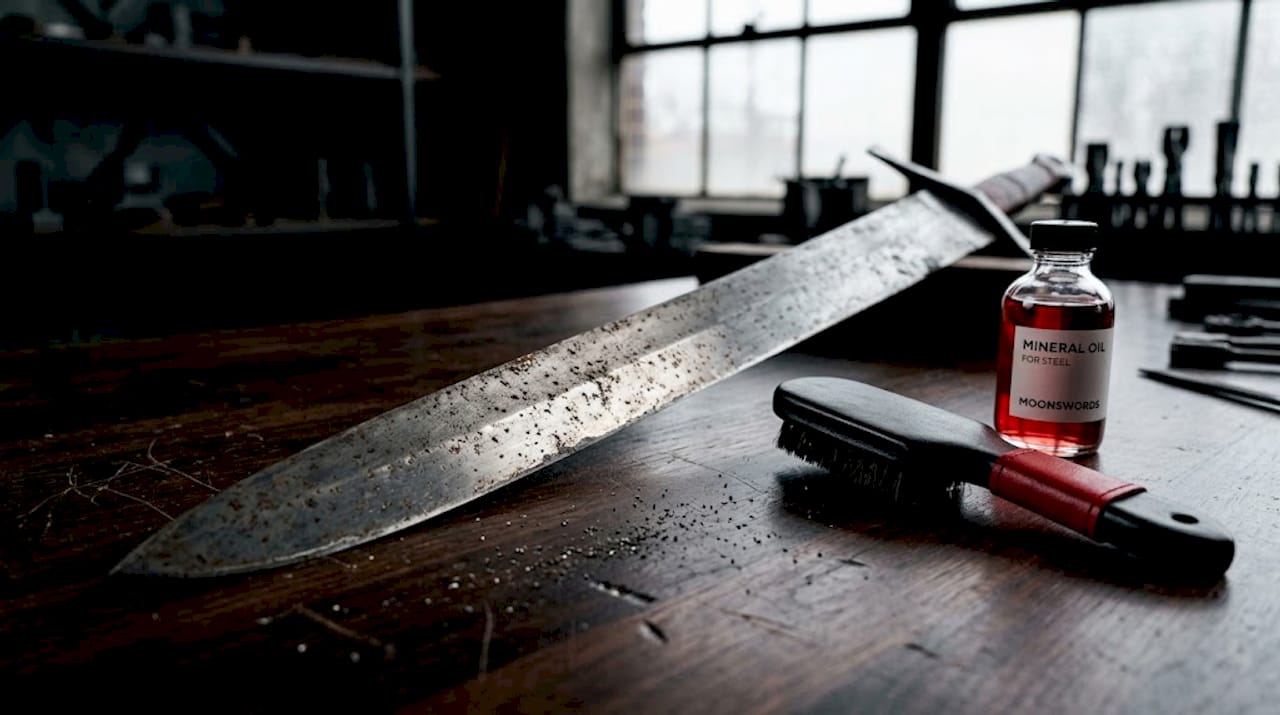
Pro Tip: Choji oil (a traditional mineral oil blend used in Japanese sword care) applied after every use is your best defense against corrosion. A thin, even coat applied with a soft cloth and buffed down to near-invisible keeps the steel protected without attracting dust or gumming up the blade.
Proper sword maintenance techniques
Good sword maintenance does not require professional tools or hours of labor. Cleaning a display sword twice a year is enough to maintain safety and condition, while a blade that is handled frequently needs attention after every handling. The process itself takes 5 to 10 minutes once you know the steps.
Step-by-step cleaning routine
- Remove the blade from its saya (scabbard) carefully, holding the handle firmly and drawing the blade away from your body.
- Wipe the blade from base to tip using a clean, soft cloth (nunochiku or similar lint-free material) to remove dust, fingerprints, and old oil.
- Inspect the blade surface closely in good light, looking for rust spots, pitting, nicks, or any discoloration that wasn’t there before.
- Apply a small amount of choji oil or mineral oil to a fresh cloth and work it along the blade in smooth strokes from base to tip.
- Buff lightly with a dry cloth to remove excess oil and leave a thin, even protective layer.
- Inspect the fittings: check that the tsuba, menuki, and handle (tsuka) are all snug, with no play or rattling when the sword is gently shaken.
What to check during inspection
Beyond cleaning, even high-quality swords can become unsafe through wear, transport damage, or poor storage. A thorough inspection covers:
- Pommel and handle wrap: Check for fraying, loosening, or separation of the tsuka-ito (handle wrap)
- Blade edge: Look for visible nicks, chips, or areas where the edge has rolled
- Blade geometry: Sight down the blade from the tip to confirm it is not warped or bent
- Nakago (tang): If possible without full disassembly, check that the mekugi (bamboo peg securing blade to handle) is intact and tight
Storage best practices
Where and how you store your sword matters as much as how you clean it. Leather sheaths retain moisture and tannins that create an oxidizing environment directly against the blade’s surface. Synthetic scabbards or oiled wooden saya are far safer alternatives for long-term storage. Store blades horizontally or edge-up in a sword stand, away from humidity, direct sunlight, and temperature extremes. A silica gel pack inside a sword bag provides useful additional moisture control.
Common maintenance mistakes that increase risk
Knowing the right techniques is only half the equation. Understanding what not to do protects you from undoing all your careful work.
- Using steel wool or abrasive cleaners on Damascus blades: Abrasive cleaners on Damascus steel scratch the surface, remove the etched visual pattern, and open new pathways for moisture to attack the blade.
- Sharpening at inconsistent angles: Inconsistent sharpening angles damage the blade geometry and degrade both the blade’s edge and its safety. Always use progressively finer whetstones and maintain a consistent angle throughout the stroke.
- Skipping inspections between uses: Wear and micro-damage accumulate gradually. A problem visible in today’s inspection prevents an injury the next time you handle the blade.
- Storing in leather sheaths without oiling: A leather sheath that looks protective is chemically aggressive against uncoated steel. Either oil the blade heavily before sheathing or switch to a wooden or synthetic option.
- Ignoring professional service when needed: A blade with a significant warp, deep pitting, or a cracked mekugi is beyond home maintenance territory. Continuing to use it while waiting to “get around” to a repair is a genuine safety risk.
The sword community often falls into the trap of thinking that a blade looks fine, so it must be fine. Structural issues do not always show on the surface. That is precisely why a consistent inspection habit matters.
Why maintenance is a safety practice, not a chore
Framing sword upkeep as maintenance understates what it actually is. Every cleaning session is a safety inspection. Every application of choji oil is a choice to keep the blade’s performance predictable. Every check of the fittings is a decision to stay in control of your sword rather than letting wear make those decisions for you.
“Respect for the blade and respect for yourself are the same practice. A well-maintained sword does not surprise you.”
Routine cleaning and oiling protect the blade’s long-term integrity, and the time invested, rarely more than a few minutes, compounds over years into a blade that remains both beautiful and safe. Collectors who care for their swords properly preserve not just the steel but the craftsmanship and history embedded in every forged layer.
My honest take on sword maintenance culture
I’ve seen a pattern repeat itself more times than I can count: someone invests in a genuinely fine blade, treats the maintenance casually for a year or two, and then wonders why it no longer looks or feels the way it did. Or worse, they discover a hairline crack in the nakago only after something went wrong during handling.
What I’ve learned is that the enthusiasts who take maintenance seriously from day one are the same people who develop the deepest understanding of their swords. When you clean a blade regularly, you notice changes. You see the early signs of corrosion before they become structural. You feel the subtle loosening of a fitting before it becomes dangerous.
My honest frustration with mainstream sword advice is that it separates maintenance from safety, treating them as different topics. They are the same topic. A properly sharpened blade that balances edge sharpness with blade integrity behaves predictably. A neglected one does not. And unpredictability, with a sharpened piece of high-carbon steel in your hand, is not something you want to discover while handling it.
If you are drawn to historical weaponry, the tradition you are connecting with has always included rigorous care. The samurai did not treat sword maintenance as a burden. They understood that the sword’s reliability was a direct reflection of the attention given to it. That is not nostalgia. That is engineering wisdom that has never stopped being true.
— Kenji
Explore Moonswords’ hand-forged blade collection

At Moonswords, every blade we offer is built with the kind of construction that makes proper maintenance both rewarding and worthwhile. Full-tang forging, quality steel selection, and traditional finishing techniques mean that when you follow the best practices for sword maintenance outlined here, the results actually show. Our hand-forged katana collection includes options for every level of collector, from accessible entry-level pieces to museum-grade masterworks. For those beginning their collection, our entry-level katana range offers full-tang construction and reliable steel that responds well to consistent care. Browse our high-end katana collection if you are ready to invest in a blade forged to the standards that make lifelong maintenance truly meaningful.
FAQ
What happens if you never clean your sword?
Neglecting cleaning allows rust and corrosion to weaken the steel, compromising the blade’s structural integrity and making it unsafe to handle, even as a display piece.
How often should a sword be oiled?
Display swords benefit from cleaning and oiling at least twice a year, and any blade should be wiped down and re-oiled after it has been handled, since fingerprints and skin oils accelerate rust.
Why are leather sheaths dangerous for sword storage?
Leather retains moisture and contains tannins that create an oxidizing environment against the blade, which can cause rust spots on carbon or Damascus steel within 12 to 24 hours.
Can a loose handle fitting cause injury?
Yes. A loose tsuba or shifting handle reduces the user’s control when the sword is drawn, sheathed or handled, which can cause the blade to shift unexpectedly and result in injury to the handler or bystanders.
Is it safe to sharpen your own sword?
Sharpening is safe when done correctly using progressively finer whetstones at a consistent angle and with moderate pressure. Inconsistent technique damages blade geometry and undermines both performance and safety.