

Touching another warrior’s scabbard without permission was not a minor social gaffe in feudal Japan. It could get you killed. To understand warrior class sword etiquette is to recognize that every gesture, every placement, every angle of the blade carried meaning that could signal peace, challenge, rank, or intent in an instant. For martial artists and collectors today, these traditions are not museum pieces. They are living protocols that sharpen your practice, deepen your connection to warrior culture, and protect you from serious missteps in any formal martial arts setting.
Table of Contents
- Foundations of warrior class sword etiquette
- Preparing your sword and posture for proper etiquette
- Executing traditional sword presentation and handling techniques
- Common etiquette pitfalls and how to avoid them
- The moral and cultural significance of sword etiquette
- Why mastering sword etiquette is a discipline of both heart and skill
- Explore master-crafted katanas to enhance your warrior journey
- Frequently asked questions
Key Takeaways
| Point | Details |
|---|---|
| Sword etiquette reflects respect | Proper handling and presentation of a warrior sword express trust, honor, and social rank. |
| Precise posture and placement | Sitting posture and sword placement convey peaceful intent and prevent misunderstanding. |
| Rank dictates presentation | Different ranks have distinct ways to present and receive swords signaling social hierarchy. |
| Avoid common pitfalls | Mistakes like improper draw start and accidental saya contact undermine etiquette and can provoke offense. |
| Etiquette embodies bushido | Mastery of etiquette merges skill with moral discipline and respect for tradition and the sword’s spirit. |
Foundations of warrior class sword etiquette
The katana was never simply a weapon. In feudal Japan, it was a declaration of identity. Loyalty, class, and personal honor were all encoded in how a samurai wore, carried, and handled his sword. The right to wear a katana was legally restricted to the warrior class, the bushi, and carrying one in public was itself a statement of social standing. Lower-ranking warriors wore their swords less prominently, while high-status samurai displayed them in ways that communicated authority without a single spoken word.
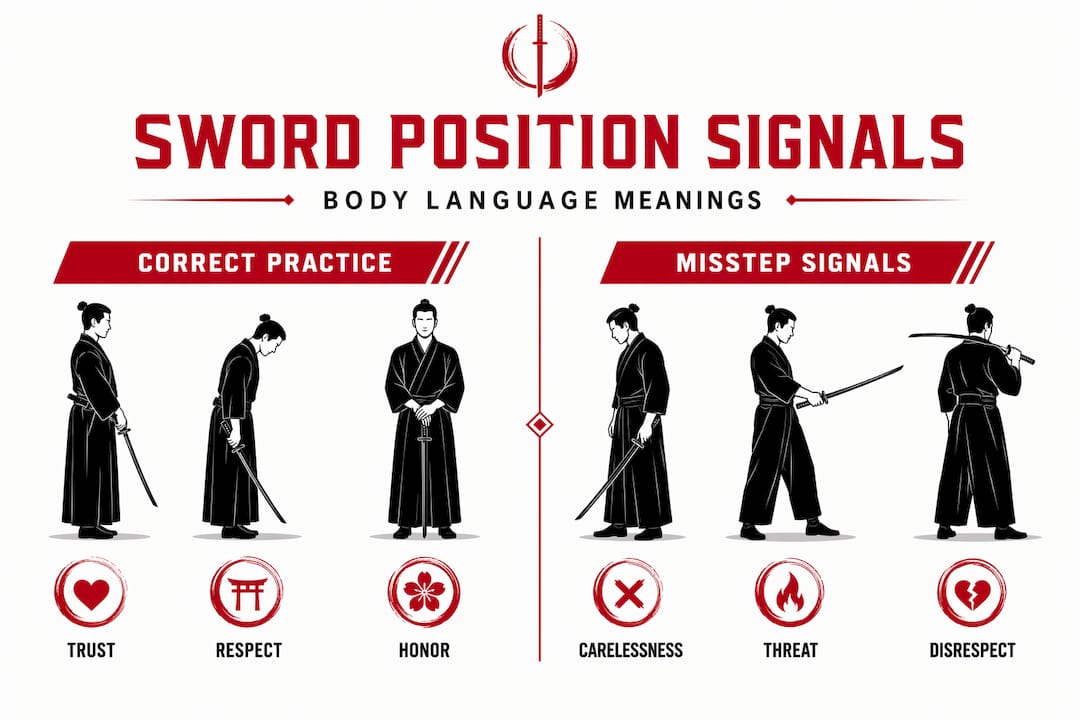
The nonverbal language of the sword ran deep. How a warrior positioned his hand near the tsuka (hilt) in conversation, whether the blade faced inward or outward on his belt, and even the angle of the scabbard during a bow all communicated specific messages. Peace. Readiness. Submission. Threat. A samurai reading another’s sword posture could assess intent before a word was exchanged. This is the foundation that makes traditional katana presentation so much more than ceremony.
Key symbolic meanings encoded in sword etiquette:
- The katana as the tamashii (soul) of the samurai, treated with the same reverence as a sacred object
- Sword placement at the left hip (standard carry) versus right hip (a deliberate signal of peaceful intent in formal settings)
- The daisho (paired katana and wakizashi) as a visual declaration of full warrior status
- Touching or bumping another’s saya (scabbard), known as saya-ate, as a direct insult capable of triggering a duel
- The direction of the tsuka during rest or presentation as a constant nonverbal message
| Sword position | Meaning communicated |
|---|---|
| Tsuka angled toward recipient | Trust and respect |
| Blade edge facing inward | Peaceful intent |
| Right hand near tsuka in conversation | Aggression or readiness |
| Sword placed on right side in seiza | Formal deference and peace |
| Daisho worn openly | Full samurai status |
With this cultural foundation established, let’s move into how you physically prepare yourself and your sword to honor these traditions properly.
Preparing your sword and posture for proper etiquette
Before you present or handle a warrior-class sword, your body and your blade must both be ready. Etiquette begins before the sword is touched. The formal seated posture, seiza, is the starting point for most ceremonial sword interactions. Kneel with your knees on the mat, heels tucked under your body, and your arms resting naturally at your sides without tension or visible gap between your arms and torso. Eyes are lowered slightly, not cast down in shame, but in measured calm.
Sword placement in seiza is precise and intentional. In seiza, the sword sits on the right with the tsuka facing toward yourself and the blade edge (ha) turned inward. This position makes a fast draw physically impossible, which is exactly the point. It signals that you pose no threat. Reversing this, placing the sword on the left with the edge outward, communicates the opposite.
Step-by-step preparation for seiza sword placement:
- Enter the space calmly and move to your designated position without rushing
- Lower into seiza by placing the left knee down first, then the right
- Settle your weight evenly across both heels
- Place the sword on your right side, tsuka pointed toward your body, ha facing inward
- Rest your hands on your thighs, fingers together, without gripping or tension
- Lower your gaze naturally, maintaining peripheral awareness
Physical care that reflects respect:
- Clean the blade with uchiko (polishing powder) and wipe with nuguigami (special Japanese paper) after every handling session
- Apply a thin coat of clove oil or traditional choji oil to prevent oxidation, working from the base toward the tip
- Store the sword horizontally in its shirasaya (plain wooden scabbard) when not in use
- Never touch the blade surface with bare fingers, as skin oils accelerate rust
Pro Tip: If you are practicing with an authentic katana, check the mekugi (bamboo peg securing the tsuka) before every session. A loose mekugi during a formal presentation is both dangerous and a visible sign of neglect.
| Preparation element | Correct practice | Common error |
|---|---|---|
| Seiza sword side | Right side, tsuka toward self | Left side, edge outward |
| Blade care | Choji oil after handling | No oil, bare finger contact |
| Tsuka direction | Toward self at rest | Pointed outward toward others |
| Eye position | Slightly lowered | Fully downcast or staring |
Once prepared correctly, you are ready to move into the detailed mechanics of presenting and handling the sword with the authority these traditions demand.
 Executing traditional sword presentation and handling techniques
Sword presentation is where warrior sword skills and martial etiquette for warriors converge most visibly. The way you offer a sword to another person communicates your rank, your intent, and your understanding of the tradition in one fluid motion.
Rank-based presentation differences:
- A person of lower rank presents with both arms extended fully, palms facing upward, the sword resting across both hands
- Higher rank uses one hand on the center of the saya, projecting confidence and authority without full submission
- The blade edge (ha) faces the giver during presentation, not the recipient, as a gesture of humility
- The tsuka is always directed toward the recipient, enabling them to draw immediately if they choose
Drawing the sword, or nukitsuke, follows equally strict warrior class combat protocols. The draw must begin precisely at the body’s center point, the tsubamoto (base of the guard), not from the left side of the body. This is a technical requirement in seitei iaido (standardized sword drawing practice) that many beginners violate without realizing it.
Step-by-step sword drawing protocol:
- Begin from a stable, centered stance with weight evenly distributed
- Place the left hand on the saya at the koiguchi (mouth of the scabbard)
- Initiate the draw from the body’s center, not the left hip
- Execute the nukitsuke in one smooth arc, not a jerky pull
- Complete the cut and pause with controlled breathing
- Perform chiburi (the motion to clear blood from the blade) with the left hand gripping the koiguchi firmly before releasing
Etiquette in drawing techniques is inseparable from budo itself, expressing respect for teachers, training partners, and the art’s lineage in every repetition.
Pro Tip: When practicing how to wield a sword in formal settings, slow down your presentation deliberately. Speed signals aggression. Measured, unhurried movement signals mastery and respect. Instructors notice the difference immediately. You can study examples of wakizashi handling to see how the same principles apply across blade types.
| Rank | Presentation method | Signal conveyed |
|---|---|---|
| Lower rank | Both arms extended, palms up | Deference and respect |
| Higher rank | One hand on saya center | Confidence and authority |
| Equal rank | Mutual bow, tsuka toward recipient | Mutual respect |
After mastering presentation and handling, it is essential to recognize and avoid the common mistakes that quietly undermine your etiquette.
Common etiquette pitfalls and how to avoid them
Even experienced practitioners make errors that carry real consequences in formal settings. Many fail seitei noto by starting the sword draw from the left side of the body rather than the required center. This single error violates the foundational rule of standardized sword drawing and is immediately visible to any trained observer.
Improper chiburi technique and saya-ate are two other errors that carry both technical and social penalties. Chiburi performed with a late palm push or incorrect left-hand grip looks sloppy in competition and signals incomplete training. Saya-ate, accidentally bumping another person’s scabbard, is a far more serious matter.
“Accidental saya-ate in crowds could spark duels as insult, highlighting the need for utmost care in crowded settings.”
Common sword handling rules violations to watch for:
- Drawing from the left hip instead of the body center during nukitsuke
- Gripping the koiguchi too loosely during chiburi, causing the saya to shift
- Allowing the right hand to drift across the body centerline during ukenagashi (deflection technique), exposing a technical gap
- Making eye contact while presenting a sword to a senior, which reads as a challenge
- Rushing the bow that accompanies sword exchange, which signals impatience
Pro Tip: In any crowded dojo or demonstration setting, always be aware of your saya’s arc as you move. Common sword handling mistakes often happen during transitions, when you are focused on the next position rather than the current one. Train the transitions as carefully as the techniques themselves.
Understanding these pitfalls prepares us to appreciate how etiquette embodies the warrior’s moral code and cultural identity at its deepest level.
The moral and cultural significance of sword etiquette
Sword etiquette is not a checklist. It is a daily practice of character. Sword discipline reflects loyalty, self-discipline, and the bushido moral code, balancing intellectual development with warrior spirit. Every time a samurai cleaned his blade, stored it with care, or presented it with the correct posture, he was expressing his values, not just following rules.
Etiquette is inseparable from budo, teaching sincere respect for teachers, training partners, and the art’s entire lineage. This is why a careless bow or a rushed presentation is not a small thing. It signals a practitioner who has learned the form but missed the meaning.
Why the moral dimension matters:
- Honoring the sword honors the craftsmen whose tradition spans more than a thousand years of forging knowledge
- Consistent etiquette practice builds emotional control, the same quality that made warriors effective under pressure
- Treating the sword as sacred creates a mindset of responsibility that carries into every aspect of martial training
- Mastering etiquette is a lifelong path, not a milestone you reach and move past
“The katana is the soul of the samurai, and how you handle it reveals the quality of your character as clearly as any technique.”
Explore samurai culture insights to continue building the cultural context that makes these practices genuinely meaningful rather than performative.
Why mastering sword etiquette is a discipline of both heart and skill
Here is something we rarely say plainly enough: most practitioners learn the mechanics of sword etiquette and stop there. They get the hand positions right, they remember which side the sword goes on in seiza, and they consider the job done. But the mechanics without the intention behind them are just theater.
We have seen this distinction clearly in our work with serious collectors and martial artists. The practitioners who carry genuine authority in a dojo are not the ones who perform etiquette most precisely. They are the ones for whom etiquette has become a natural expression of how they think about the sword and the people around them. Their bow is not a rule they are following. It is a genuine acknowledgment of the person in front of them.
This matters practically, too. Etiquette training builds the kind of emotional regulation that makes you a better sparring partner, a more attentive student, and a more trustworthy practitioner. You learn to slow down, to read the room, to communicate without speaking. These are not soft skills. They are warrior skills, the same qualities that made the best samurai effective in both the court and the field.
Modern sword enthusiasts sometimes treat etiquette as a historical curiosity, something to perform at demonstrations. We think that misses the point entirely. The spirit of these protocols, respect for the weapon, awareness of others, clarity of intent, is just as relevant in a contemporary dojo as it was in a feudal court. Embrace the spirit, not just the form, and your martial arts etiquette reflections will carry weight that purely technical training cannot provide.
Explore master-crafted katanas to enhance your warrior journey
If you are committed to honoring sword etiquette with integrity, the sword you own and handle matters. A blade that is poorly balanced, cheaply constructed, or historically inaccurate makes it harder to develop the feel and respect that proper etiquette demands.

At MoonSwords, our master-crafted katanas are hand-forged by skilled artisans using clay tempering, full tang construction, and centuries-old techniques that produce blades worthy of the traditions you are studying. The Black Dragon Katana is a strong starting point for collectors who want a blade that honors both form and craftsmanship. For those exploring the full daisho tradition, the Hayabusa wakizashi pairs beautifully with our katana collection and rewards the careful handling etiquette demands. Start your collection with a sword that is worthy of your respect and commitment. For actual drawing and kata practice in the dojo, rely on a bokken or an unsharpened iaito chosen with your instructor.
Frequently asked questions
Why is the tsuka (hilt) directed toward the recipient when presenting a sword?
Directing the tsuka toward the recipient symbolizes trust, giving the recipient the ability to draw immediately if needed, which is a deliberate act of respect and vulnerability from the presenter.
What is the significance of placing the sword on the right side while sitting seiza?
Sword placed on the right side with the tsuka toward yourself and the ha facing inward makes a swift draw physically impossible, communicating peaceful intent in formal settings.
How does proper sword etiquette reflect the samurai moral code?
Proper sword etiquette embodies bushido by expressing loyalty, honor, and self-discipline. Sword discipline reflected on the warrior’s family and lord, balancing intellectual development with the demands of warrior life.
What are the common mistakes to avoid in sword presentation?
Key errors include starting the draw from the left rather than the body center, incorrect chiburi grip timing, and accidental saya-ate (scabbard contact), which can cause serious social offense or even provoke a challenge.
Why is etiquette inseparable from practicing budo?
Etiquette inseparable from budo means that every bow, every presentation, and every draw expresses continual respect for teachers, training partners, and the art’s lineage, making it integral to the philosophy of martial practice, not just its form.
Recommended
- News
- Hayabusa Wakizashi | MoonSwords 30.7 Inch Clay-Tempered Steel
- Black Dragon Katana - MoonSword Guild Manganese Steel Sword
- Dragon Soul 龙魂 Tang Dynasty Sword Forged by Master Peiyan Zhao