

Few topics in swordsmithing generate more myth than the sword folding technique explained through legend rather than metallurgy. You’ve probably heard claims of swords folded “a million times” or that more folds equal a stronger blade. Neither is true. Folding was a practical answer to a real problem: inconsistent, impurity-laden raw steel that ancient Japanese smiths had no other way to refine. In this guide, we walk through the actual process, the science behind it, and what it means for you as a collector or practitioner choosing a blade today.
Table of Contents
- What is sword folding and why was it developed?
- The folding process explained step by step
- The metallurgy behind folding: benefits and limitations
- Comparing traditional folded steel with Damascus and uniform steels
- Applying sword folding knowledge to craftsmanship and collecting
- A craftsman’s perspective: what folding really means today
- Explore expertly folded swords crafted by master smiths
- Frequently asked questions
Key Takeaways
| Point | Details |
|---|---|
| Purpose of folding | Folding was developed to purify inconsistent tamahagane steel by removing impurities and equalizing carbon content. |
| Typical folds | Traditional swords are folded 10 to 16 times, producing thousands of layers, not hundreds of thousands or millions. |
| Limits of folding | Overfolding burns carbon from steel, softening the blade and reducing edge quality. |
| Comparative metallurgy | Japan’s folding technique differs from Damascus steel layering and modern uniform steels in process and purpose. |
| Modern relevance | Folding now preserves aesthetics and tradition more than structural strength in contemporary swords. |
What is sword folding and why was it developed?
The sword folding technique didn’t emerge from mysticism or a desire for ritual. It emerged from necessity. Japanese smiths working with tamahagane (the raw steel smelted from iron sand in a traditional clay furnace called a tatara) faced a fundamental problem: the steel was wildly inconsistent. Some areas were high in carbon, others nearly iron. Slag, gas pockets, and other impurities were distributed throughout the billet.
“Japanese smiths worked with inconsistent, impurity-laden steel requiring folding to produce reliable blades” — a reality that shaped the entire sword making process for centuries.
Folding addressed all of these issues at once. By repeatedly heating, hammering flat, and folding the billet back on itself, smiths could:
- Distribute carbon evenly across the steel mass
- Force out slag and impurities through the forge-welding pressure
- Identify and eliminate weak spots before they became structural failures in a finished blade
- Create a more homogeneous material from what started as a chaotic, inconsistent billet
This was not a spiritual act. It was engineering with the tools available. Understanding this context matters because it reframes how we evaluate swords today. You can read more about traditional forging techniques overview on our resource pages, but the key insight is this: folding solved a materials problem specific to pre-industrial Japan. Smiths in other regions with access to more consistent steel sources had less reason to develop the same technique.
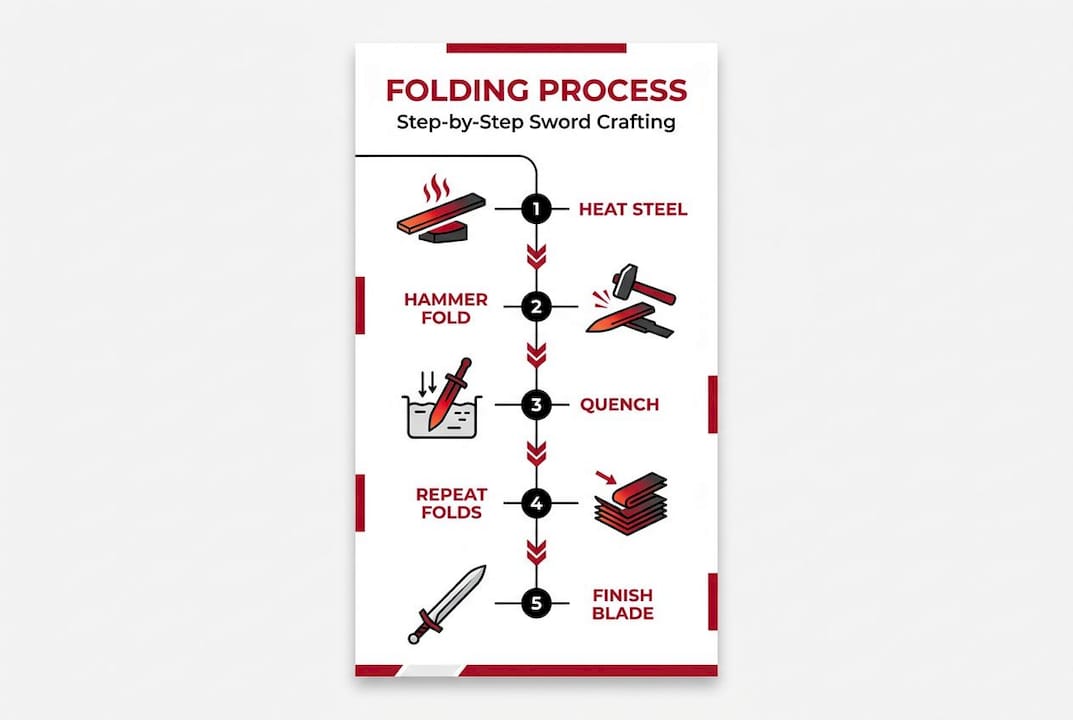
The folding process explained step by step
Now that we understand why folding was necessary, let’s walk through each stage of the process so you can see exactly how layers multiply and what a smith is actually doing during those long hours at the forge.
- Prepare the tamahagane billet. The raw steel is sorted by carbon content, with higher and lower carbon pieces selected and sometimes combined intentionally to hit a target range.
- Heat to forge-welding temperature. The billet is brought to approximately 1100 to 1200°C, hot enough for the steel to become plastic and for layers to fuse under hammer pressure.
- Hammer flat. The glowing billet is worked on the anvil until it forms an even, flat shape. This is where impurities begin to be expelled.
- Fold the billet. The flattened steel is folded back on itself, either lengthwise or crosswise depending on the smith’s intention for the final grain pattern (hada).
- Forge-weld the fold shut. The folded billet is returned to the fire, brought back to temperature, and hammered again to fuse the two halves into one solid piece.
- Repeat. Each complete fold doubles the layer count. This cycle is repeated until the smith reaches the intended number of folds.
The math here is worth pausing on. The layer count grows exponentially, not linearly.
| Number of folds | Layer count |
|---|---|
| 8 | 256 |
| 10 | 1,024 |
| 12 | 4,096 |
| 14 | 16,384 |
| 16 | 65,536 |
The visible grain pattern left on the blade surface is called the hada (skin pattern). Depending on how the smith folds, straight or diagonal, the hada takes on different appearances: masame (straight grain), itame (wood-grain), or mokume (burl pattern). This is not decoration added afterward. It is a direct record of the folding process itself, which is why experienced collectors read the hada as a window into a blade’s craftsmanship.
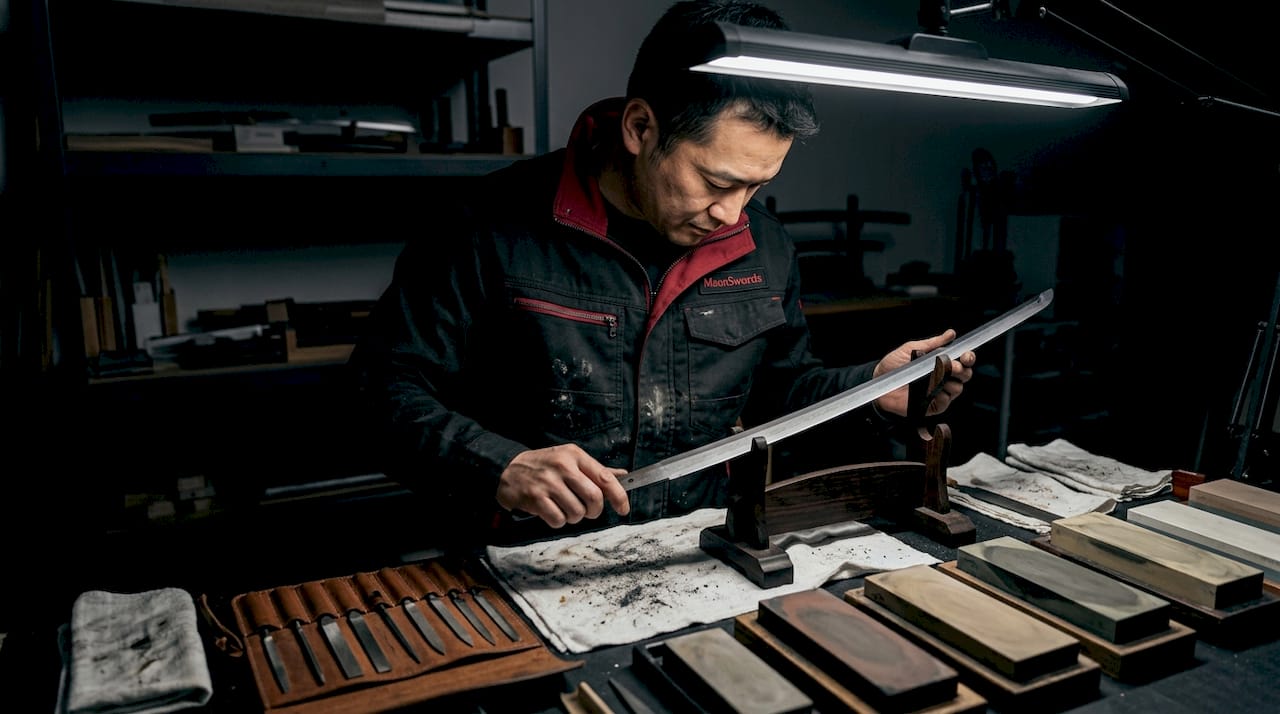
Pro Tip: When examining a folded blade, look at the hada under good lighting at a low angle. A consistent, fine-grained hada indicates controlled, even folding. Irregular or absent hada may signal machine grinding or misrepresentation of the forging method.
The entire folding session for a quality katana can span several hours across multiple forge sessions.
The metallurgy behind folding: benefits and limitations
Understanding the mechanics of folding helps appreciate the real advantages and why careful folding is critical during the forging process.
The core benefits of traditional metal folding techniques are specific and measurable:
- Carbon homogenization: Tamahagane starts with wildly varying carbon percentages. Folding spreads that carbon more evenly throughout the billet, producing steel that behaves predictably during hardening.
- Slag removal: Each hammer blow at forge-welding temperature squeezes out non-metallic inclusions. More folds mean more opportunities to expel these weaknesses.
- Material consistency: The finished billet, after folding, is a far more uniform material than what the smith started with.
Here is where the myth breaks down, though. Layer count is not a direct indicator of strength. More layers do not mean a harder or tougher blade. In fact, the opposite becomes true past a certain point.
“Excessive folding beyond 16 times burns carbon, weakening blades, so experienced smiths stop between 10 and 16 folds to maintain hardness.”
Carbon is what gives steel its ability to harden. When you overfold, you expose the steel to the fire too many times, and carbon literally burns off into the atmosphere. The blade becomes softer. This is why claims of swords folded thousands of times are not just exaggerated; they describe a blade that would be closer to iron than steel.
| Steel type | Folding benefit | Limitation |
|---|---|---|
| Tamahagane | High: removes slag, homogenizes carbon | Overfolding burns carbon |
| Modern high-carbon steel (T10, 1095) | Minimal: already uniform | Folding adds little metallurgical benefit |
| Damascus pattern steel | Aesthetic and some carbon blending | Pattern can delaminate under stress |
Differential hardening, the process of applying clay to the spine before quenching (which creates the famous hamon temper line), works in partnership with folding. Folding gives you consistent steel to work with; differential hardening then creates a hard edge and tough spine from that consistent material. Our Akitsu katana uses clay-tempered T8 carbon steel that demonstrates exactly this relationship between material preparation and final heat treatment.
Pro Tip: When a seller claims their blade was folded “over 30,000 times,” that’s a layer count, not a fold count. Thirty-two thousand layers requires only 15 folds. The two numbers are not the same thing, and conflating them is a common marketing trick.
Comparing traditional folded steel with Damascus and uniform steels
With the metallurgy clear, exploring other layered steel traditions like Damascus sharpens your understanding of the sword folding technique’s unique role in the broader world of sword craftsmanship explained through history.
Damascus sword folding (more accurately called pattern welding) is a different process with a different goal. Where Japanese folding works within a single type of steel to purify and homogenize it, Damascus pattern welding forges alternating layers of different steels together, typically a high-carbon and a low-carbon variety, then manipulates those layers through twisting, cutting, and restacking to create visual patterns.
| Feature | Japanese folded steel | Damascus pattern steel | Modern uniform steel |
|---|---|---|---|
| Primary purpose | Purify inconsistent tamahagane | Create layered visual pattern | Consistent performance from the start |
| Steel types used | Single steel type | Two or more steel types | Single, pre-refined alloy |
| Pattern origin | Natural result of folding (hada) | Intentionally manipulated and etched | None |
| Metallurgical advantage | Removes impurities in raw steel | Some carbon gradient at edge | Predictable, consistent properties |
| Cultural origin | Japan | Middle East, Europe | Modern industrial production |
Key distinctions worth remembering:
- The hada on a Japanese folded blade is a byproduct of the purification process, not the goal
- The pattern on a Damascus blade is the goal, achieved through deliberate layer manipulation and acid etching
- Modern uniform steels like T10 or 1095 are already refined at the mill, so folding adds little metallurgical benefit but can still produce a hada for aesthetic and traditional purposes
- Both folded and Damascus blades carry significant cultural and artistic value beyond their material properties
Our Damascus steel katana shows what skilled pattern welding looks like when applied to a katana form, blending that layered visual tradition with Japanese blade geometry.
Applying sword folding knowledge to craftsmanship and collecting
With a firm grasp of folding techniques and metallurgy, you’re ready to apply this knowledge to appreciate and select quality swords more confidently.
Informed collectors understand that the balance between layer count and carbon retention is what separates genuine craftsmanship from marketing fiction. Here’s how to put that understanding to work:
- Verify realistic fold counts. Authentic traditionally folded blades fall between 10 and 16 folds. Any claim of hundreds or thousands of folds describes layers, not folds, and should prompt further questions.
- Examine the hada. A genuine folded blade shows a visible grain pattern in the steel. If the surface is perfectly uniform with no grain, the blade was likely stock removal (ground from flat bar stock) rather than forge-folded.
- Check the steel specification. Quality folded blades will list the steel type (tamahagane, T10, 1095, etc.).
- Evaluate the hamon. A real clay-tempered blade has an irregular, organic hamon line. A perfectly uniform or painted-on hamon indicates a blade that was not differentially hardened.
- Ask about the smith or forge. Reputable sellers can tell you where and how the blade was made. Provenance matters in traditional sword craftsmanship, explained through a verifiable process.
Pro Tip: The hada and hamon together tell the story of a blade’s making. A smith who folds well and tempers well leaves evidence of both in the finished steel. Learning to read these markers is the single most valuable skill a collector can develop.
Our Koshu katana and Kinchiku katana both reflect these standards, with documented steel types, visible hada, and authentic clay tempering that you can examine and verify.
A craftsman’s perspective: what folding really means today
Here is the view we hold at MoonSwords after years of working with master smiths and studying traditional sword forging closely: folding is a purification technique, not a strength multiplier. That distinction matters more than most enthusiasts realize.
Folding primarily purifies poor tamahagane steel; modern uniform steels see little metallurgical benefit from folding, and overfolding actually softens steel by burning away carbon. This is not a criticism of folding. It is a clarification of what folding actually does, which is something far more interesting than the myths suggest.
What we find most compelling is the cultural argument for preserving folding as a craft. When a smith folds steel today using traditional methods, they are practicing a form of material knowledge that took centuries to develop. The judgment calls, when to stop folding, how to read the billet’s color, and how to feel the hammer’s feedback, cannot be reduced to a formula. That embodied knowledge is worth preserving even when modern steel technology has outpaced the practical need for it.
The uncomfortable truth is that a blade made from well-sourced, uniform modern steel and properly heat-treated will often outperform a traditionally folded blade in raw mechanical tests. But that framing misses the point entirely. Traditional sword forging is not competing with industrial production. It is carrying forward a lineage of craft that connects a modern practitioner to a 700-year-old tradition of swordsmithing. That has value. It just isn’t the value that marketing claims about fold counts would have you believe.
Our expert smith insights section explores more of these nuanced conversations about tradition versus performance in modern blade making.
Explore expertly folded swords crafted by master smiths
At MoonSwords, we believe the folding process should be visible in the blade you hold, not just described in a product listing. Our collection of premium hand-forged katanas is built by master smiths who understand both the metallurgical purpose and the cultural weight of traditional folding techniques.

Whether you’re drawn to the visible hada of a traditionally folded blade or the striking layered patterns of a Damascus steel katana, every piece in our collection comes with documented steel specifications and authentic forging methods. The Black Dragon katana is a strong starting point for collectors who want to see hand-folded craftsmanship expressed in a full-tang, hand-forged, display-worthy blade. Explore the collection and bring what you’ve learned here into the selection process.
Frequently asked questions
How many times is a katana traditionally folded?
Traditional katana steel is usually folded between 10 and 16 times, producing thousands of layers without overfolding that would damage the blade’s carbon content and hardness.
Does more folding make a sword stronger?
No. Folding distributes carbon and removes impurities, but excessive folding burns carbon, making the blade softer rather than stronger, which is why experienced smiths stop well before 20 folds.
Why do modern swords sometimes have folded steel patterns?
Modern swordsmiths fold steel to preserve traditional craftsmanship and produce an authentic hada pattern, even though modern uniform steels are already refined enough that folding adds minimal metallurgical benefit.
How does folding remove impurities from steel?
Folding drives out impurities by repeatedly heating and hammering the billet at forge-welding temperatures, which squeezes out slag and non-metallic inclusions while simultaneously homogenizing the carbon distribution throughout the steel.
What should sword enthusiasts know before buying a folded steel sword?
Look beyond fold counts and focus on verifiable quality indicators like steel type, visible hada, and authentic hamon. Informed collectors know that real craftsmanship is readable in the blade itself, not just in the marketing copy.