

When you research samurai sword making traditions, you quickly discover that you’re not studying a single craft. You’re studying an intersection of metallurgy, spiritual philosophy, aesthetic theory, and generational knowledge that has survived over seven centuries of war, peace, and modernization. The terminology alone can stop a new researcher cold. What does hamon actually tell us about a blade’s heat treatment? How does tamahagane differ from modern steel? This guide walks you through the materials, the forging process, the cultural vocabulary, and the pitfalls to avoid so your research is accurate, grounded, and genuinely rewarding.
Table of Contents
- Key takeaways
- Researching samurai sword making traditions: materials and terminology
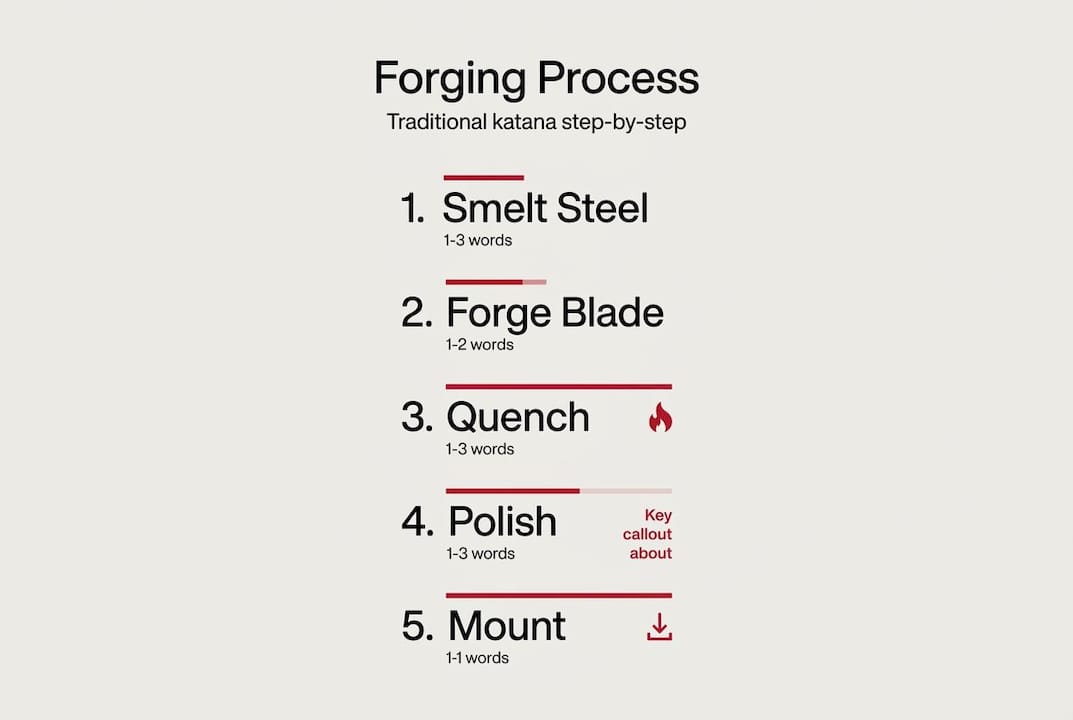
- The traditional forging process, step by step
- Cultural and spiritual significance in sword-making traditions
- Common myths and research pitfalls
- My perspective on researching this tradition
- Explore hand-forged katanas at Moonswords
- FAQ
Key takeaways
| Point | Details |
|---|---|
| Tamahagane is the foundation | This specialized steel, smelted from iron sand in a tatara furnace, creates the carbon variation that defines blade performance. |
| Terminology unlocks sources | Mastering terms like tanren, hamon, and jigane is required to read primary sources and technical descriptions accurately. |
| Forging is a multi-stage process | From smelting to polishing, each stage produces specific physical and aesthetic outcomes that researchers must understand in sequence. |
| The sword carries spiritual weight | Understanding the sword as a cultural artifact, not just a weapon, transforms how you interpret historical and technical records. |
| Myths distort research accuracy | Common misconceptions about pattern-welding and forging timelines can seriously mislead researchers who rely on secondary sources. |
Researching samurai sword making traditions: materials and terminology
Before you can read a historical text on samurai sword craftsmanship with any real comprehension, you need to understand what the sword is actually made of and what the craftsmen were actually doing. Without that foundation, the vocabulary used in primary sources becomes noise.
The steel that starts everything
The raw material for traditional Japanese sword making is tamahagane, a steel produced by smelting iron sand with charcoal in a clay furnace called a tatara. The process runs continuously for 36 to 72 hours, with workers feeding iron sand (satetsu) and charcoal in carefully controlled intervals. The result is a bloom of steel with varying carbon concentrations, some sections hard and brittle, others soft and tough. That variation is the point. It gives the swordsmith raw material with different mechanical properties to work with during forging.
Modern research has pinpointed the science behind what traditional craftsmen learned through observation alone. Tamahagane forms near the eutectoid temperature of 720 to 723°C, with carburization requiring roughly 10.5 to 16 hours for approximately three tons of iron under controlled humidity conditions. Traditional smiths didn’t have thermometers. They read the color of the fire and the behavior of the material. That empirical knowledge, accumulated and transmitted across generations, is one of the most remarkable aspects of the tradition.

Essential terminology for researchers
The following terms appear constantly in technical literature on samurai sword craftsmanship. Misunderstanding even one of them can lead to misreading a source entirely.
- Tanren: The folding and hammering process used to refine tamahagane, distributing carbon evenly and eliminating impurities. The number of folds is sometimes cited as a marker of quality, though this is more nuanced than popular accounts suggest.
- Hamon: The visible temper line along the blade’s edge, created during the clay-coating and quenching process. It reflects both the metallurgical boundary between hard and soft steel and the craftsman’s aesthetic choices.
- Jigane: The surface texture of the blade steel, showing the pattern of the folded layers. Like the hamon, it functions as both a technical indicator and an artistic signature.
- Sori: The curvature of the blade, which developed historically in response to the shift from foot combat to mounted cavalry fighting.
- Tatara furnace: The traditional clay smelting furnace used to produce tamahagane. Building and operating one requires specialized knowledge that is itself a distinct craft tradition.
| Term | What it describes | Cultural meaning |
|---|---|---|
| Tamahagane | Raw steel from iron sand smelting | Foundation of the blade’s character |
| Tanren | Folding and forging process | Discipline and refinement |
| Hamon | Temper line along the edge | Craftsman’s aesthetic signature |
| Jigane | Surface steel texture | Record of the blade’s making |
| Sori | Blade curvature | Adaptation to combat and history |
Pro Tip: When reading older Japanese texts on swordmaking, be aware that the same term can carry slightly different meanings depending on the period and school. Cross-reference at least two technical sources when a term’s definition affects your interpretation.
The traditional forging process, step by step
Understanding how samurai swords are made in sequence is what allows researchers to contextualize individual techniques. Each stage produces specific outcomes, and those outcomes affect every subsequent step.
-
Smelting in the tatara furnace. Iron sand and charcoal are fed into the tatara over multiple days. The resulting bloom contains steel with varying carbon content, which the swordsmith then breaks apart to select sections with the right properties.
-
Sorting and initial shaping. High-carbon steel (for the edge) and low-carbon steel (for the core) are selected separately. The swordsmith forms these into workable billets through initial hammering.
-
Folding and consolidation (tanren). The billets are heated, hammered flat, folded, and hammered again. This process, repeated multiple times, distributes carbon evenly and removes slag inclusions. The folding also creates the layered hada (grain pattern) visible in a finished blade.
-
Combination forging. The hard outer steel (kawagane) is wrapped around the softer inner core (shingane). This structure gives the finished blade both an edge that holds sharpness and a spine that absorbs impact without shattering.
-
Rough shaping (sunobe). The combined billet is drawn out to approximate the blade’s final length, profile, and curvature. The smith establishes the basic geometry here.
-
Clay coating and quenching (tsuchioki and yaki-ire). A mixture of clay, ash, and stone powder is applied to the blade in a specific pattern, thicker along the spine and thinner near the edge. When the blade is heated and plunged into water, the differential cooling creates the hamon and locks in the hardness of the edge. This is the most technically demanding step and where many blades are lost to cracking.
-
Rough and fine polishing (togi). A specialist polisher (often a separate craftsman) works through progressively finer stones to reveal the hamon, the jigane, and the final geometry of the blade. The polishing process can take weeks and is considered an art in its own right.
Pro Tip: The quenching step (yaki-ire) is where the majority of blade failures occur during traditional production. When you encounter historical accounts of a swordsmith’s output rate, factor this in. A high yield was genuinely exceptional, not a given.
Cultural and spiritual significance in sword-making traditions
A sword is not just a blade. Japanese swordmaking tradition has been continuously passed down for more than 700 years, and the craft carries cultural and spiritual meaning that no purely technical description can capture. Researchers who treat the sword only as a metallurgical object miss the largest part of the story.
Japanese swords historically represented the warrior’s soul. The tameshi-giri (test cutting) was not simply a quality check. It was a ceremonial validation of the blade’s spiritual worth, its capacity to fulfill the role assigned to it. To understand the written records around these tests, you need to hold both the technical and the symbolic dimensions at once.
“The Japanese sword’s value lies beyond functionality; it embodies a nearly thousand-year-old tradition preserving both technique and spiritual essence, deeply resonating internationally.” — Forging a Supreme Blade
Transmission of knowledge follows an equally cultural logic. Traditional sword apprenticeships take around 10 years of full-time, live-in training. That structure is not just practical. It mirrors the relational model through which spiritual values, aesthetic judgments, and technical instincts are passed from master to student in a form that written records cannot fully reproduce.
Here are the cultural concepts most likely to appear in research on this tradition and to require more than a dictionary definition:
- Tamashii: Soul or spirit, the quality invested in a blade through the swordsmith’s focused intention.
- Wabi: An aesthetic of understated beauty, visible in the way the hamon and jigane are appreciated for their quiet complexity.
- Shokunin: The craftsman ethic of total dedication to one’s craft, applied to swordsmiths, polishers, and sheath makers alike.
- Iemoto system: The school-based transmission of technical and artistic lineage, which shapes how techniques are classified and attributed in historical records.
You can explore how sword making became sacred across cultures to see how this spiritual framing is not unique to Japan, though it reached a particular depth there. For a broader timeline of how the craft evolved across historical periods, Moonswords’ guide to Japanese sword making eras provides useful collector-oriented context.
Common myths and research pitfalls
Misconceptions about samurai sword forging techniques are not just common in popular culture. They appear in secondary academic sources too, which makes critical source evaluation especially important.
| Myth | What research actually shows |
|---|---|
| Pattern-welding strengthens the blade | Pattern-welding serves primarily aesthetic purposes; it does not significantly enhance mechanical properties. |
| More folds always means better quality | Excessive folding can raise carbon content to problematic levels; the goal is purification, not accumulation of layers. |
| One swordsmith makes the whole sword | Polishing, handle fitting, and scabbard making are typically done by separate specialists with their own apprenticeship traditions. |
| Traditional methods are imprecise | Modern metallurgy confirms that traditional heat treatment variables align closely with scientifically derived optimal parameters. |
| The forging takes days | The full process from tamahagane to finished, polished blade can take months of active work across multiple craftspeople. |
 The pattern-welding myth deserves particular attention. It persists because it sounds plausible. Layered steel has a visual complexity that implies structural superiority. But the mechanical evidence does not support it. Researchers who rely on sources written for a general audience often inherit this assumption without questioning it.
Modern swordsmiths blend empirical tradition with scientific methods, which creates another potential confusion: distinguishing between accounts of historical practice and accounts of current practice. A source describing heat treatment techniques in a modern workshop is not necessarily describing what happened in a 14th-century forge.
Pro Tip: When evaluating a source, check whether it distinguishes between historical practice and contemporary revival. Many excellent modern resources conflate the two, which is fine for general audiences but problematic for rigorous research.
The award received by master swordsmith Kaneda Tatsuki at the 2026 Contemporary Sword Exhibition after 12 years of submissions and 8 years of full-time training illustrates just how long genuine mastery takes. It also provides a useful calibration point: if you encounter historical claims about a swordsmith achieving mastery quickly, treat them with appropriate skepticism.
My perspective on researching this tradition
I’ve spent years studying samurai sword craftsmanship, and the most surprising thing I’ve found is how much the vocabulary resists casual translation. Not linguistically, but conceptually. A word like jigane carries aesthetic, historical, and metallurgical weight simultaneously. When I first encountered it, I treated it as a technical term. I was missing two-thirds of what it meant.
What I’ve learned is that the best researchers in this field move fluidly between scientific literature and cultural history. The metallurgy papers published in journals like the Tetsu-to-Hagane give you the physical truth of what’s happening at the steel level. The historical records from apprenticeship traditions give you the human truth of how that knowledge was held and transmitted. Neither source alone is sufficient.
The dedication embodied in this craft also recalibrates your expectations for your own research. Mastery here takes not years but decades, and the standards are uncompromising. That spirit, I think, should inform how you approach the study itself. Slow down. Read primary sources. Resist the convenient shortcut of a Wikipedia summary or a YouTube video, no matter how well produced.
My honest take: most researchers underestimate how much the spiritual framing of swordmaking affects the technical records. Accounts of a particular hamon style are not just aesthetic descriptions. They are statements about lineage, school affiliation, and cultural values. Ignore that layer, and you’re reading a translation with half the words removed.
— Kenji Smith
Explore hand-forged katanas at Moonswords
If researching traditional Japanese sword making has deepened your appreciation for what goes into a genuine blade, we invite you to see that craftsmanship expressed in physical form.

At Moonswords, every katana in our collection is hand-forged by master artisans using techniques grounded in the same traditions covered in this guide: clay tempering, folded steel construction, and careful attention to hamon geometry. Whether you’re a collector looking for a museum-quality piece or a martial artist seeking a blade with authentic provenance, our hand-forged Japanese swords reflect the standards this tradition demands. Browse our high-end katana collection to find blades that honor the craft you’ve been studying.
FAQ
What is tamahagane and why does it matter?
Tamahagane is the traditional steel used in Japanese sword making, produced by smelting iron sand with charcoal in a tatara furnace over 36 to 72 hours. Its variable carbon content is what allows swordsmiths to create blades with a hard edge and a tough, flexible core.
How long does traditional samurai sword forging take?
The full process from raw tamahagane to a finished, polished blade can take several months, involving the swordsmith, a specialist polisher, and other craftspeople. Traditional apprenticeships alone require approximately 10 years of full-time training before independent production begins.
What is the hamon on a samurai sword?
The hamon is the visible temper line along the blade’s edge, created when clay-coated steel is quenched in water. It marks the metallurgical boundary between hard edge steel and softer spine steel, and also serves as a unique aesthetic signature of the individual craftsman’s style.
Does folding steel actually make a sword stronger?
Folding primarily refines the steel by distributing carbon evenly and removing impurities, not by multiplying layers for structural strength. Pattern-welding, sometimes confused with traditional folding, serves mostly aesthetic purposes and does not significantly improve mechanical performance.
Where can I find credible sources for researching samurai sword traditions?
Peer-reviewed metallurgy journals, museum catalogs from institutions like the Tokyo National Museum, and specialized publications on Japanese arms and armor are the most reliable sources. Cross-referencing technical metallurgy research with cultural history texts gives you the most complete picture of the tradition.