

Most people assume the answer to why samurai carried two swords comes down to one thing: status. It is an easy conclusion to reach, especially when you see the iconic silhouette of a warrior with two blades at his hip. But that assumption misses most of the story. The paired swords, known as the daishō (literally “big-little”), represented a fusion of battlefield practicality, legal identity, spiritual philosophy, and social authority that evolved over centuries of Japanese history. Understanding this tradition changes how you see the samurai entirely.
Table of Contents
- Key takeaways
- The origin of the daishō
- Combat practicality of carrying two swords
- Symbolism and cultural meaning of the daishō
- Daily life and legal authority of two swords
- How the samurai tradition compares globally
- My perspective on the dual sword tradition
- Own a piece of this history with Moonswords
- FAQ
Key takeaways
| Point | Details |
|---|---|
| The daishō was exclusive to samurai | Only samurai could legally wear both swords, making the pair a marker of class and legal authority. |
| Each sword had a distinct tactical role | The katana excelled in open combat while the wakizashi was favored for indoor fighting and close quarters. |
| Miyamoto Musashi formalized two-sword combat | His Niten Ichi-ryū style treated both blades as a unified weapon system, not two separate tools. |
| Swords became spiritual and social symbols | Especially during the Edo period, swords represented a samurai’s honor, soul, and rank far beyond battlefield use. |
| Legal restrictions reinforced sword identity | Laws governing who could carry swords tied blade-wearing directly to samurai class privilege and policing authority. |
The origin of the daishō
To understand why samurai carried two swords, you need to understand how the pairing developed in the first place. It was not an overnight decision. The Japanese sword-making tradition spans over a thousand years, and the specific pairing of long and short blades emerged gradually through changes in warfare, politics, and culture.
Early samurai warriors primarily carried the tachi, a longer curved blade worn edge-down suspended from a belt. The tachi was designed for mounted combat, where a downward drawing cut from horseback made tactical sense. As warfare shifted increasingly to foot combat during the 14th and 15th centuries, swordsmiths developed the katana, a shorter curved blade worn edge-up through the belt (obi). This new carrying method allowed for a faster draw and a simultaneous cut, which gave foot soldiers a decisive edge in close fighting.
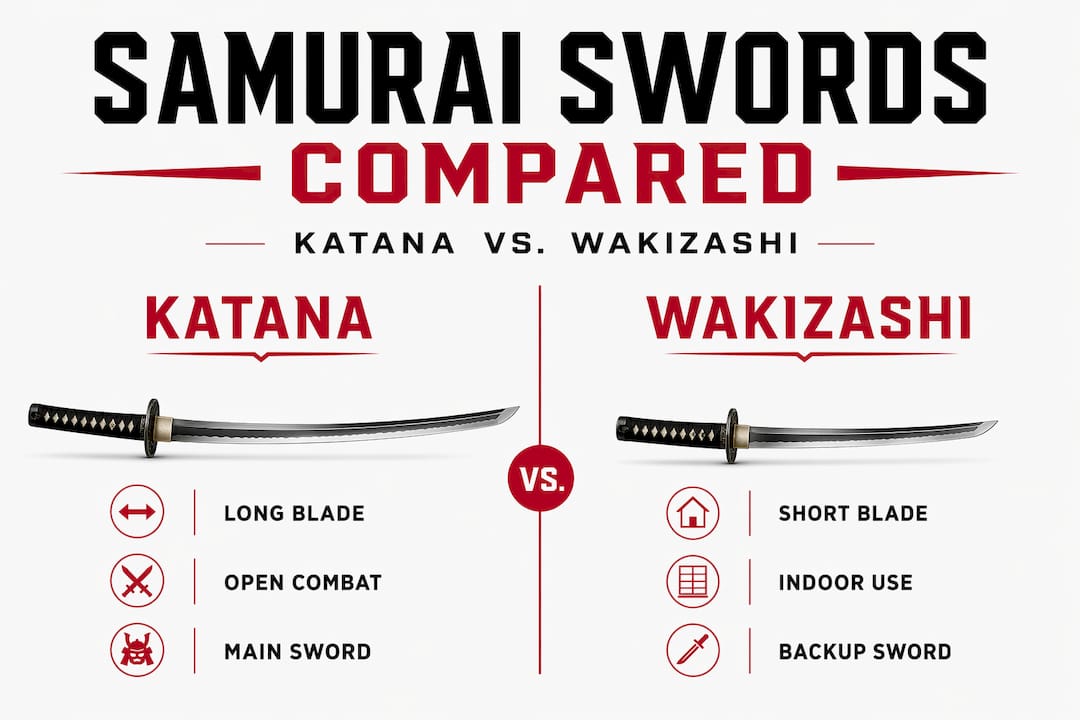
The wakizashi, with a blade typically between 12 and 24 inches, emerged as a natural companion to the katana. Here is what defined each sword:
- Katana: Blade length of 24 inches or more; the primary weapon for outdoor battle and open combat engagements
- Wakizashi: Shorter companion blade; suited for indoor fighting, tight corridors, and backup use when the katana could not be drawn
- Tachi: The earlier long blade worn edge-down; primarily a mounted cavalry weapon
- Tantō: A short dagger sometimes worn alongside other blades; used in rituals and close-quarter defense
The daishō as a formalized matched set became culturally established during the Muromachi period (1336 to 1573) and was fully codified during the Edo period (1603 to 1868). Matching the fittings, tsuba (guard), menuki (grip ornaments), and saya (scabbard) of both blades became a mark of refined taste and social standing.
| Sword type | Blade length | Primary use |
|---|---|---|
| Katana | 24+ inches | Open battle, primary weapon |
| Wakizashi | 12 to 24 inches | Indoor combat, backup weapon |
| Tachi | 27+ inches | Mounted cavalry combat |
| Tantō | Under 12 inches | Ritual use, close defense |
The craftsmanship binding both blades into a unified set was itself a statement. A samurai’s daishō was often commissioned as a single artistic project, with the swordsmith and metalworker creating matching aesthetics across both pieces. The forging ceremonies surrounding katana production were treated as spiritual rituals, not manufacturing processes. This elevated the daishō from a weapons pair into a crafted identity.
Combat practicality of carrying two swords
The symbolic weight of the daishō should not overshadow its very real tactical logic. Samurai carried two swords because having two swords gave them measurable combat advantages. The most famous proof of this comes from Japan’s most celebrated swordsman.

Miyamoto Musashi, who lived from 1584 to 1645, developed a two-sword fighting system known as Niten Ichi-ryū, which translates roughly to “two heavens as one.” Where most kenjutsu schools treated the katana as the dominant weapon and the wakizashi as a last resort, Musashi’s approach used both blades simultaneously as a coordinated tactic. He carried both swords into duels and deployed them together as a unified method rather than as independent options.
His system offered several specific combat advantages:
- Simultaneous offense and defense: Wielding a blade in each hand allowed Musashi to attack with the katana while using the wakizashi to deflect incoming strikes, removing the need to choose between attack and defense on each movement.
- Spatial unpredictability: An opponent trained to read a single-sword fighter had to recalibrate entirely when facing two blades. The angles of attack multiplied, creating hesitation.
- Backup readiness: In a grappling situation or if the primary blade was pinned, the wakizashi gave an immediate close-range response without drawing a new weapon.
- Psychological pressure: Facing two live blades created a cognitive load for opponents that a single sword did not. Musashi understood this and used it deliberately.
Musashi’s technique was forged through actual combat across more than 60 recorded duels, not developed in a training hall. The Niten Ichi-ryū method is still taught today under the name Hyōhō Niten Ichi-ryū, which confirms that his two-sword approach was a viable and sophisticated fighting system.
Pro Tip: If you study kenjutsu or iaijutsu, practicing slow-motion paired draw with a bokken (wooden practice sword) set is one of the most effective ways to understand how the katana and wakizashi were meant to work together as a system, not just as backup options.
Beyond Musashi’s school, the katana and wakizashi each covered different combat ranges. Carrying both meant a samurai was never without the right tool for the scenario in front of him.
Symbolism and cultural meaning of the daishō
As Japan entered the long peace of the Edo period, the battlefield utility of the daishō faded. But its cultural weight grew. Swords became art pieces and status symbols rather than active battlefield weapons, and the emotional and spiritual significance of the pairing intensified.
Japanese culture has long treated the katana as an extension of the samurai’s soul. This was not a poetic metaphor. It was a lived belief embedded in the warrior class. A samurai’s sword was named, cared for with ritual precision, and passed through generations as a living inheritance.
“The sword is the soul of the samurai.” — Japanese proverb attributed to Ieyasu Tokugawa
The daishō, as a matched set, carried that spiritual weight in doubled form. The paired swords symbolized social power and personal honor, with the pairing itself communicating rank in a way that a single blade could not. Walking into a room wearing both swords told everyone present exactly who you were in the social order.
The cultural roles the daishō played during the Edo period included:
- Social rank marker: Only samurai could legally wear both blades in public. Merchants, farmers, and artisans were excluded by law.
- Spiritual guardian: Many samurai believed their swords housed protective spiritual power, and the pair was treated with corresponding reverence.
- Ceremonial anchor: Swords accompanied samurai at weddings, coming-of-age ceremonies, and before battle through prescribed rituals.
- Artistic legacy: Commissioned daishō sets became heirlooms where the metalwork, lacquer, and silk wrapping were judged as fine art.
The Edo period shift from warrior tool to cultural icon did not diminish the daishō. It deepened its meaning. A samurai who never saw battle still wore his swords every day because doing so was an act of identity, not armament.
Daily life and legal authority of two swords
Beyond ceremony and combat, the dual sword tradition served a very concrete function in samurai daily life. The two swords were not left at home when the fighting was done. They were worn constantly, and each one had a specific role depending on where a samurai found himself.
The wakizashi served multiple practical roles that the katana simply could not fill in everyday situations:
- The katana was typically left at the door when entering a home or a castle. Drawing a long blade indoors was physically impractical in tight Japanese architectural spaces with low ceilings and sliding partitions.
- The wakizashi stayed on the samurai’s person indoors, functioning as his active defense weapon in close quarters. This was not a courtesy rule; it was a tactical reality.
- During sleep, the wakizashi was kept within arm’s reach. The katana could not be drawn quickly from a lying position.
- In certain ceremonial contexts, particularly seppuku (ritual suicide), the wakizashi was the prescribed instrument, cementing its role as the more intimate, personal blade of the two.
Samurai also held law enforcement and peacekeeping responsibilities throughout Japanese society, and carrying rights were legally tied to samurai identity. The daishō was not just worn for self-defense. It was the visible authority that gave samurai the legal standing to enforce order, collect taxes, and administer justice in their domain.
Pro Tip: When displaying a katana and wakizashi together on a traditional katana-kake (sword rack), the katana is placed on the upper tier with the edge facing upward and the wakizashi below. This arrangement mirrors how the blades were actually worn and shows proper respect for the set’s hierarchy.
The Tokugawa government’s sword-hunt edicts, which restricted blade-carrying to the samurai class, made the daishō a legal credential as much as a weapon. Wearing both swords in public was, in itself, an assertion of class privilege backed by state law.
How the samurai tradition compares globally
Warrior cultures across history have favored paired or backup weapons. But the specific tradition of carrying two matched swords as a codified social and martial institution is distinctly Japanese. The contrast is instructive.
| Warrior tradition | Primary weapon | Backup/paired weapon | Cultural codification |
|---|---|---|---|
| Japanese samurai | Katana | Wakizashi (daishō pair) | Legally mandated, spiritually significant |
| European knight | Longsword | Dagger (misericorde) | Tactical but not class-coded |
| Ottoman sipahi | Kilij (curved saber) | Yatagan dagger | Functional, regional variation |
| Chinese cavalry | Dao (saber) | None standardized | Battlefield practical, not paired |
| Viking warrior | Sword | Seax (short knife) | Personal choice, not institutionalized |
European knights often carried a dagger for finishing blows in armor gaps, which is functionally similar to the wakizashi’s backup role. But no European warrior class turned the specific pairing of two blades into a legally enforced class marker with spiritual dimensions. That combination of law, identity, and spiritual meaning is what separates the daishō tradition from anything else in global martial history.
The geography of Japan contributed to this specificity. Island warfare, castle sieges, and the tight architectural spaces of Japanese urban life all shaped how weapons were used. A fighting tradition that required both open-field capability and indoor close-quarter ability naturally produced exactly the solution the daishō provided.
My perspective on the dual sword tradition
I’ve spent years studying why people are drawn to the samurai, and what I keep coming back to is this: the dual sword tradition is one of the most honest expressions of who the samurai actually were. Not just warriors. Not just aristocrats. Both, at the same time, inseparably.
What I find most misunderstood is that collectors and enthusiasts often treat the katana and wakizashi as separate purchases rather than a unified statement. In my experience, the pair together communicates something neither blade can say alone. A katana on its own is impressive. A matched daishō set is a declaration.
I’ve also noticed that most people who discover Musashi’s Niten Ichi-ryū style are genuinely surprised that two-sword fighting was a formal, tested school of combat and not a cinematic invention. That surprise tells me the practical military logic of the daishō is still dramatically underappreciated, even among serious enthusiasts. The swords were real weapons used by real fighters. Honoring that history starts with understanding it fully, not just admiring the aesthetics.
The cultural continuity is also worth recognizing. The same reverence for blade craftsmanship that shaped Edo period daishō commissions is alive today in the hands of master smiths working with clay tempering and traditional folding techniques. That thread does not break.
— Bre
Own a piece of this history with Moonswords

If the history behind the daishō tradition has given you a deeper appreciation for these swords, the next step is holding that history in your hands. At Moonswords, we carry handcrafted katanas and wakizashis forged by master artisans using clay tempering and full tang construction. Our authentic Japanese sword collection includes everything from entry-level pieces for new collectors to high-end blades built for display and light training. If you are looking to start with a traditional wakizashi, the Hayabusa Wakizashi is one of our most historically grounded pieces. Every blade we offer is made to honor the tradition you have just read about.
FAQ
Why did samurai carry two swords instead of one?
Samurai carried two swords because each blade served a distinct purpose. The katana was the primary weapon for open combat while the wakizashi handled indoor defense, close-quarter fighting, and ceremonial roles.
What is the name for the samurai’s paired swords?
The paired swords are called the daishō, which translates literally as “big-little.” The daishō could only be worn by samurai, making the pair a legally enforced symbol of class identity and social rank.
Did samurai actually fight with two swords at once?
Yes, though it was not universal practice. Miyamoto Musashi developed the Niten Ichi-ryū two-sword method, a formal fighting system using both katana and wakizashi simultaneously as a unified tactic rather than two separate weapons.
What was the wakizashi used for in daily life?
The wakizashi was kept on the samurai’s person indoors when the katana was left at the entrance, used as a sleeping defense blade, and deployed in close-quarter combat. It also held ceremonial significance in samurai rituals including seppuku.
Were samurai the only ones allowed to carry two swords?
Yes. Sword-carrying laws in feudal Japan restricted the wearing of the daishō exclusively to the samurai class. Merchants, farmers, and other social classes were legally prohibited from carrying both blades, which made the pair an unmistakable marker of samurai authority.